
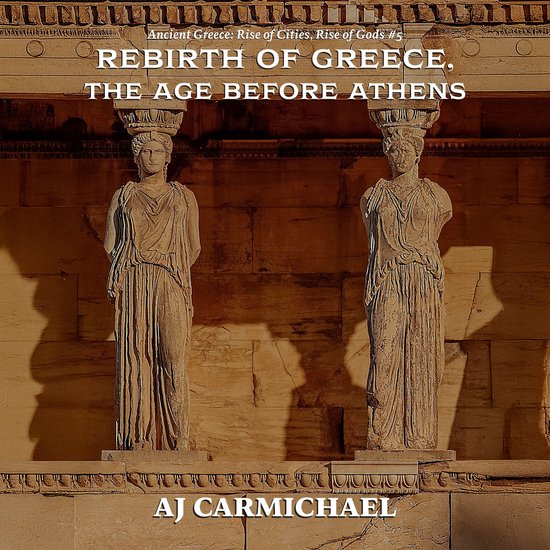
Rebirth of Greece, The Age Before Athens
AJ CARMICHAEL
- 19 december 2025
- 9798260870907
Samenvatting:
This audiobook is narrated by a digital voice.
Ancient Greece emerged from collapse to create one of the most influential political and cultural systems in human history. After the fall of the Bronze Age palaces, Greek communities rebuilt themselves not through empire or kingship, but through cooperation, law, and shared civic identity. This book explores how scattered villages evolved into self-governing city-states, tracing the rise of the polis as a revolutionary social experiment that reshaped politics, warfare, religion, and everyday life. From the recovery of agriculture and trade to the formation of assemblies, councils, and written law, it reveals how ordinary citizens became active participants in their own governance.
Focusing on the formative centuries before the Classical age, this work examines the institutions, values, and lived realities that defined early Greek society. It explores citizenship and exclusion, land and economy, religion and ritual, warfare and collective identity, and the architectural spaces where public life unfolded. Rather than presenting Greece as an inevitable triumph, it shows the polis as a fragile and contested achievement—one born from adaptation, negotiation, and shared responsibility. Essential reading for anyone interested in the origins of political life, civic identity, and the foundations of Western civilization.