
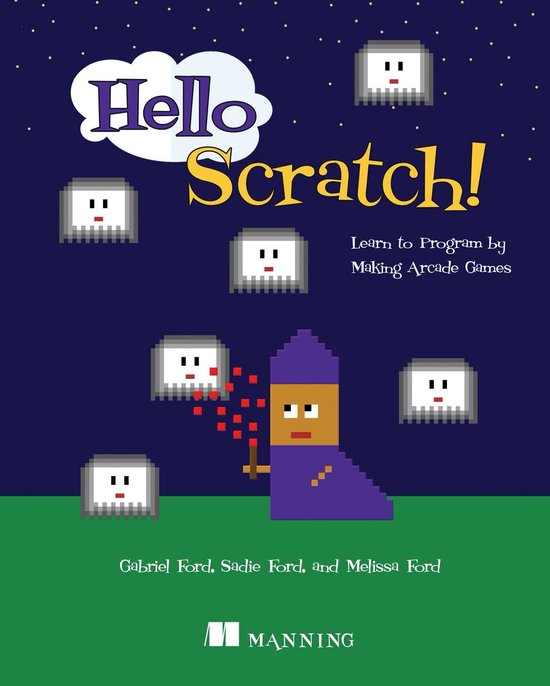
Hello Scratch!
Melissa Ford
- 31 oktober 2017
- 9781638354246
Samenvatting:
Summary
Hello, Scratch! is a how-to book that helps parents and kids work together to learn programming skills by creating new versions of old retro-style arcade games with Scratch.
Purchase of the print book includes a free eBook in PDF, Kindle, and ePub formats from Manning Publications.
About the Technology
Can 8-year-olds write computer programs? You bet they can! In Scratch, young coders use colorful blocks and a rich graphical environment to create programs. They can easily explore ideas like input and output, looping, branching, and conditionals. Scratch is a kid-friendly language created by MIT that is a safe and fun way to begin thinking like a programmer, without the complexity of a traditional programming language.
About the Book
Hello Scratch! guides young readers through five exciting games to help them take their first steps in programming. They'll experiment with key ideas about how a computer program works and enjoy the satisfaction of immediate success. These carefully designed projects give readers plenty of room to explore by imagining, tinkering, and personalizing as they learn.
What's Inside
- Learn by experimentation
- Learn to think like a programmer
- Build five exciting, retro-style games
- Visualize the organization of a program
About the Readers
Written for kids 8-14. Perfect for independent learning or working with a parent or teacher.
About the Authors
Kids know how kids learn. Sadie and Gabriel Ford, 12-year-old twins and a formidable art and coding team, wrote this book with editing help from their mother, author Melissa Ford!
Table of Contents
- PART 1 - SETTING UP THE ARCADE
- Getting to know your way around Scratch
- Becoming familiar with the Art Editor
- Meeting Scratch's key blocks through important coding concepts
- PART 2 - TURNING ON THE MACHINES
- Designing a two-player ball-and-paddle game
- Using conditionals to build a two-player ball-and-paddle game
- PART 3 - CODING AND PLAYING GAMES
- Designing a fixed shooter
- Using conditionals to build your fixed shooter
- Designing a one-player ball-and-paddle game
- Using variables to build your one-player ball-and-paddle game
- Designing a simple platformer
- Using X and Y coordinates to make a simple platformer
- Making a single-screen platformer
- Using arrays and simulating gravity in a single-screen platformer
- Becoming a game maker