
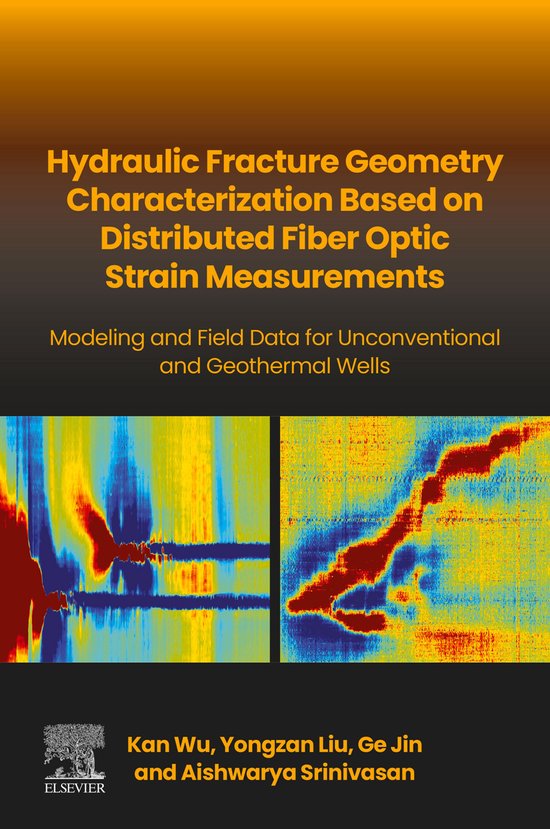
Hydraulic fracture geometry characterization based on distri ...
Kan Wu
- 05 juni 2024
- 9780323953610
Samenvatting:
Fiber optic-based measurements are innovative tools for the oil and gas industry to utilize in monitoring wells in a variety of applications including geothermal activity. Monitoring unconventional reservoirs is still challenging due to complex subsurface conditions and current research focuses on qualitative interpretation of field data. Hydraulic Fracture Geometry Characterization from Fiber Optic-Based Strain Measurements delivers a critical reference for reservoir and completion engineers to better quantify the propagation process and evolution of fracture geometry with a forward model and novel inversion model.
The reference reviews different fiber optic-based temperature, acoustic, and strain measurements for monitoring fracture behaviors and includes advantages and limitations of each measurement, giving engineers a better understanding of measurements applied in all types of subsurface formations. Stress/strain rate responses on rock deformation are given a holistic approach, including guidelines and an automatic algorithm for identification of fracture hits. Last, a novel inversion model is introduced to show how fracture geometry can be used for optimization on well placement decisions. Supported by case studies, Hydraulic Fracture Geometry Characterization from Fiber Optic-Based Strain Measurements gives today's engineers better understanding of all complex subsurface measurements through fiber optic technology.
- Learn different fiber optic-based temperature-acoustic-strain measurements for monitoring fracture behaviors along with advantages and limitations
- Know the fundamentals concepts on modeling strain/strain rate responses and develop holistic views on a variety of wells including geothermal
- Characterize complex fracture geometry to optimize well placement decisions responsibly