
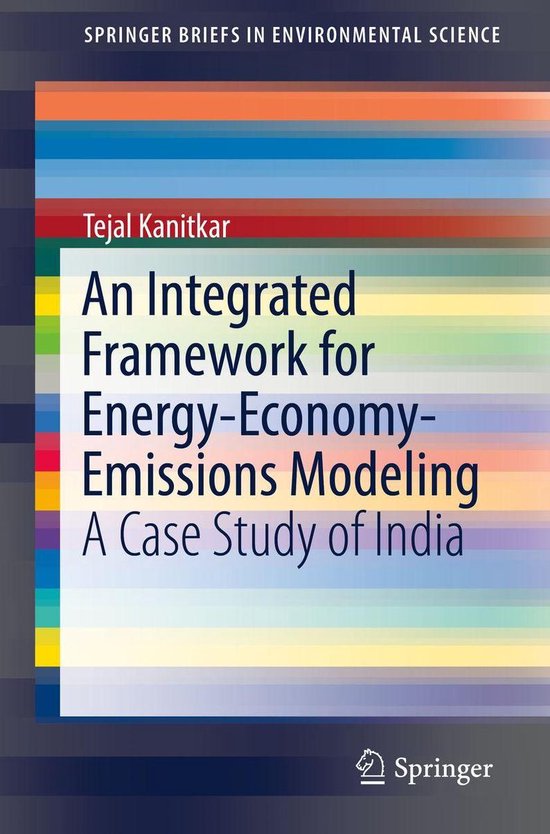
Earth and Environmental Science (R0) - An Integrated Framewo ...
Tejal Kanitkar
- 27 mei 2019
- 9783030182632
Samenvatting:
This book combines three different energy-economy-emissions modeling methodologies into one Integrated Modeling Framework (IMF) in an attempt to fill gaps in current modeling research as it applies to developing countries. Through the analysis of existing mathematical models, including large macro-economic models and technology-explicit energy models, the work proposes planning methodologies for developing countries that face challenges on their economy and infrastructure due to climate change. The three modeling methodologies discussed in the chapters are a decomposition analysis of trends in emissions intensity of GDP, linear programming techniques to determine optimum energy supply pathways given various resource and emissions constraints, and an input-output analysis to evaluate the impact of energy policies on income and equity.
After a brief introduction to the history of the development of energy studies and the linkages between energy, economic, and environmental systems, the book delves into the component methodologies of the IMF and their intended outcomes. The decomposition analysis is intended to gauge the energy intensity of GDP and the structural composition of the economy to provide a basis on which scenarios are constructed in the following two methodologies. The linear programs are meant to develop a methodology to determine energy options under a variety of scenarios that capture the technical and economic characteristics of the power sector of developing countries. Lastly, the input-output analysis aims to build a methodology through which energy policy decisions can be understood and quantified to ensure the best possible impacts on developing economies and societies. Those who will be interested in this book include policy makers, academics, and students and professionals working on energy studies and energy-economy modeling.