
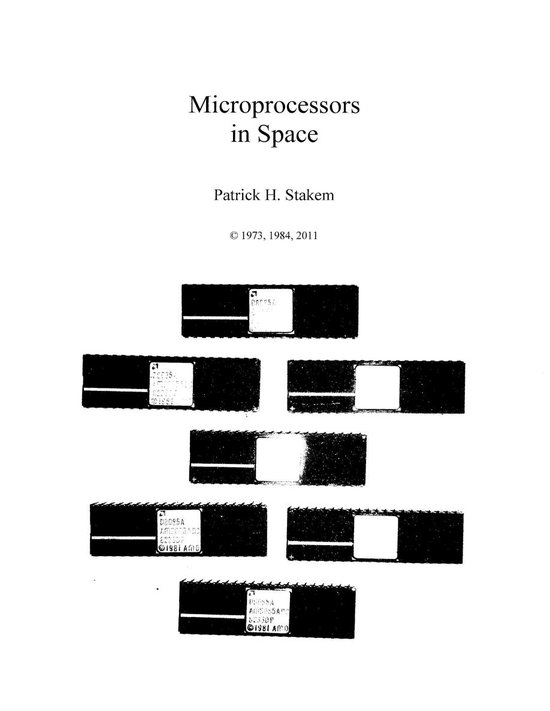
Computer Architecture - Microprocessors in Space
Patrick Stakem
- 15 november 2017
- 1230004229841
Samenvatting:
This book discusses the use of microprocessors in space missions, from the earliest 4-bit machines to the most current 64-bit implementations. We have seen the transition from monolithic processors with extensive glue logic, to IP cores instantiated in FPGA's. This discussion is not all-inclusive, but gives the high-lights of the microprocessors sent and being sent into space, and the problems of supplying and sustaining their operations there. Microprocessors orbit the earth, sit on other planets, and have left the Solar system into interstellar space. They are the key components for spacecraft autonomy, and for collecting, storing, and returning the volumes of information that we receive from off-planet sources. The basis technology for microprocessors and their associated memory and communications follows exponential growth curves in capability, referred to as "Moore's Law." Space-based electronics necessarily lags the Earth-based state-of-the-art by several generations, due to the need to address the harsh operating conditions. Spacecraft microprocessors are a special subset of embedded computers. Most spacecraft include 10's of processors, doing tasks such as attitude and orbit control, power monitoring and control, telemetry formatting and command handling, data storage management, and instrument control. Without these microprocessors, the amount that we know about our sun, neighboring planets, and the intervening space would be vastly limited.