
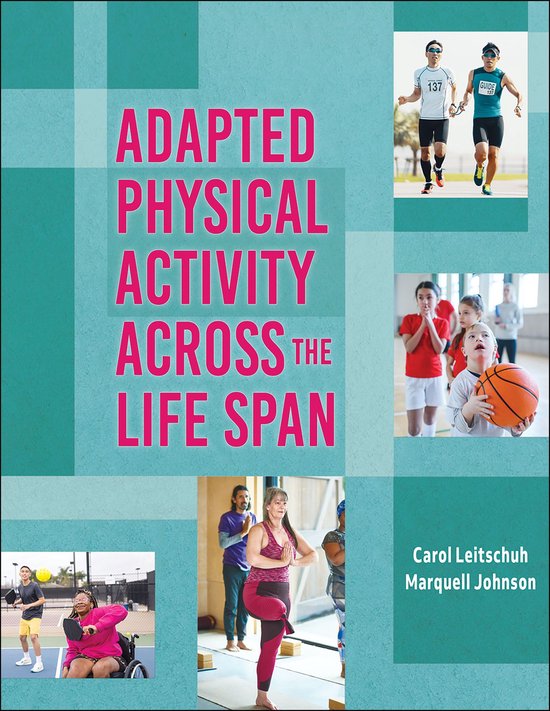
Adapted Physical Activity Across the Life Span
Carol Leitschuh
- 19 september 2023
- 9781718213371
Samenvatting:
While there are plenty of texts out there on adapted physical activity, there are none like this one.
That’s because Adapted Physical Activity Across the Life Span takes a unique interdisciplinary approach from education, sports, and the health sciences. It incorporates adapted physical activity’s long history of DEI (diversity, equity, and inclusion) and the importance of SEL (social-emotional learning) to prepare pre-professionals and professionals for service delivery in today’s world.
Adapted Physical Activity Across the Life Span features the following:
- An interdisciplinary and life span approach to show students the broad scope of careers across education, clinical, and community settings
- Interviews with professionals that provide students with real-life stories from educators, allied health care professionals, coaches, and others who work with people with disabilities
- Information about adapted physical activity for early childhood, with a focus on professions that help a young child with a disability begin their journey of adapted physical education
- Content on adapted physical education for children and young people to educate students in the full implementation of IDEA and general physical education for children with disabilities, including interdisciplinary assessments, IEPs, and program modifications
- Content on adapted physical activity for adults to enable students to understand the roles of various professions that facilitate adapted physical activity for adults—from those who recently finished high school to senior citizens—using the Healthy People guidelines, research, best practices, and the most contemporary model of aging
- Chapter objectives, chapter summaries, tables, and charts that emphasize key concepts
- Instructor ancillaries to make it easier for instructors to prepare for and teach the course
The interdisciplinary approach provides instructors greater flexibility for courses that include students not only from adapted physical education and general physical education but also from allied health professions: occupational therapy, physical therapy, speech and language pathology, nursing, medicine, sport psychology, exercise physiology, therapeutic recreation, and more.
“Today, the interdisciplinary nature of service in adapted physical activity begins in the earliest ages and continues with professionals who instruct and nurture the physical activity of the oldest of our communities,” says coauthor Carol Leitschuh. “This is the life span approach.”
Coauthor Marquell Johnson adds, “The interdisciplinary approach and life span approach provide a much wider view of helping people with disabilities achieve optimal health. Most texts focus on a narrower perspective, such as in school, in a medical or community setting, or with a certain age group. However, this book looks at all the professions that are involved in a person’s life throughout the life span and offers a coordinated approach.”
Adapted Physical Activity Across the Life Span will help prepare future professionals to serve individuals who require adaptations to be able to enjoy full and healthy active lives over their lifetimes. From infants to the elderly, all across the life span, people can be physically active—and this text will help them be just that.