
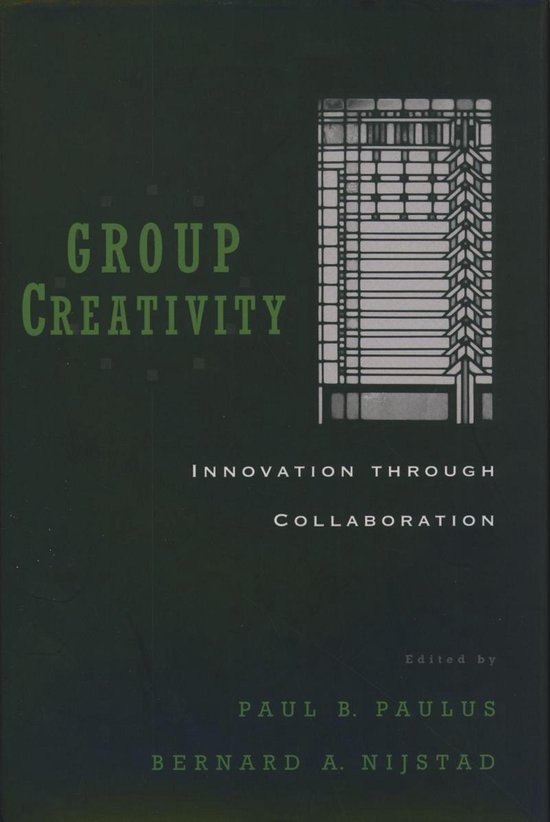
Group Creativity
Bimal Krishna Matilal
- 04 september 2003
- 9780190287252
Samenvatting:
Creativity often leads to the development of original ideas that are useful or influential, and maintaining creativity is crucial for the continued development of organizations in particular and society in general. Most research and writing has focused on individual creativity. Yet, in recent years there has been an increasing acknowledgment of the importance of the social and contextual factors in creativity. Even with the information explosion and the growing necessity for specialization, the development of innovations still requires group interaction at various stages in the creative process. Most organizations increasingly rely on the work of creative teams where each individual is an expert in a particular area. This volume summarizes the exciting new research developments on the processes involved in group creativity and innovation, and explores the relationship between group processes, group context, and creativity. It draws from a broad range of research perspectives, including those investigating cognition, groups, creativity, information systems, and organizational psychology. These different perspectives have been brought together in one volume in order to focus attention on this developing literature and its implications for theory and application. The chapters in this volume are organized into two sections. The first focuses on how group decision making is affected by factors such as cognitive fixation and flexibility, group diversity, minority dissent, group decision-making, brainstorming, and group support systems. Special attention is devoted to the various processes and conditions that can inhibit or facilitate group creativity. The second section explores how various contextual and environmental factors affect the creative processes of groups. The chapters explore issues of group autonomy, group socialization, mentoring, team innovation, knowledge transfer, and creativity at the level of cultures and societies. The research presented in this section makes it clear that a full understanding of group creativity cannot be accomplished without adequate attention to the group environment. It will be a useful source of information for scholars, practitioners, and students wishing to understand and facilitate group creativity.