
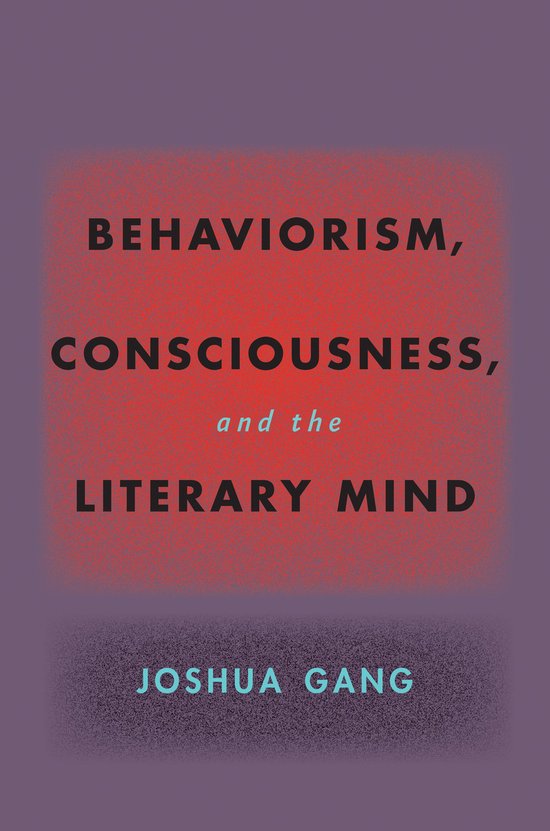
Hopkins Studies in Modernism - Behaviorism, Consciousness, a ...
Joshua Gang
- 16 november 2021
- 9781421440866
Samenvatting:
What might behaviorism, that debunked school of psychology, tell us about literature?
If inanimate objects such as novels or poems have no mental properties of their own, then why do we talk about them as if they do? Why do we perceive the minds of characters, narrators, and speakers as if they were comparable to our own? In Behaviorism, Consciousness, and the Literary Mind, Joshua Gang offers a radical new approach to these questions, which are among the most challenging philosophical problems faced by literary study today.
Recent cognitive criticism has tried to answer these questions by looking for similarities and analogies between literary form and the processes of the brain. In contrast, Gang turns to one of the twentieth century's most infamous psychological doctrines: behaviorism. Beginning in 1913, a range of psychologists and philosophers—including John B. Watson, B. F. Skinner, and Gilbert Ryle—argued that many of the things we talk about as mental phenomena aren't at all interior but rather misunderstood behaviors and physiological processes. Today, behaviorism has relatively little scientific value, but Gang argues for its enormous critical value for thinking about why language is so good at creating illusions of mental life.
Turning to behaviorism's own literary history, Gang offers the first sustained examination of the outmoded science's place in twentieth-century literature and criticism. Through innovative readings of figures such as I. A. Richards, the American New Critics, Samuel Beckett, Harold Pinter, and J. M. Coetzee, Behaviorism, Consciousness, and the Literary Mind reveals important convergences between modernist writers, experimental psychology, and analytic philosophy of mind—while also giving readers a new framework for thinking about some of literature's most fundamental and exciting questions.