
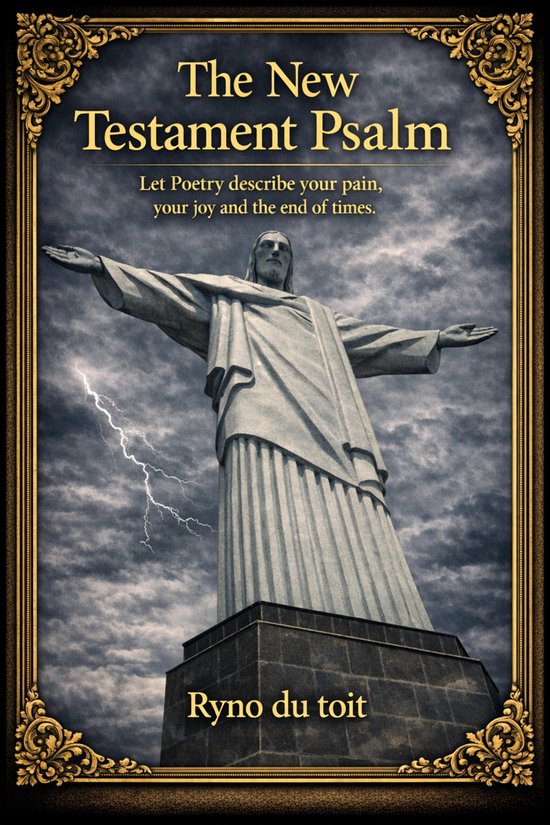
The New Testament Psalm
Ryno du toit
- 17 maart 2023
- 1230008769664
Samenvatting:
In times past, poetry spoke its own words, had its own wisdom, but can this ancient art of poetry meet the trials of the modern soul? A sacred volume emerged—a book known as The New Testament Psalm, not confined to the realm of religion alone. It stood as a guide for the weary, a mirror for those searching for words, and a voice for those unheard.
This book does not preach—it ponders poetically. It asked bold questions that echoes through the chambers of belief: Does God still dwell among us? What is faith in an age of doubt? What role does the divine play in the tangled web of today’s society? And beyond death, can we gaze into the uncertain horizon, contemplating the fate of humankind.
Within its pages, the reader would find poetic verses that did not shy away from pain. They spoke of wounds both hidden and raw—of abuse endured in silence, of love sought in digital shadows, of marriages tested by time and truth. It explored the burdens of body and spirit: the struggle with food, the complexity of desire, the weight of financial strain, the fire of anger, the pull of peers, and the shadow of addiction.
Yet, the poetry in The New Testament Psalm is not just about humans on earth; it lifts its gaze to the unseen realms, exploring the presence of Angels and the influence of Satan, and how these forces shape the world below. It traced the lives of Jesus and the Apostle Paul—not as distant figures of legend, but as living archetypes whose journeys still stir the hearts of seekers.
Most wondrous of all, the final chapters—those of Revelation—were transformed into lyrical psalms, each numbered and named, beginning with Psalm 151. These poetic renderings offered clarity and grace, allowing prophecy to be felt as much as understood.
This book is not merely read—it is experienced. It challenges the soul, stirs the mind, and opens the heart to new dimensions of truth. It is a bridge between the sacred and the secular, the ancient and the now. And so, dear seeker, the question remains: Will you step into its pages and journey through the depths of The New Testament Psalm, in ancient poetic language?