
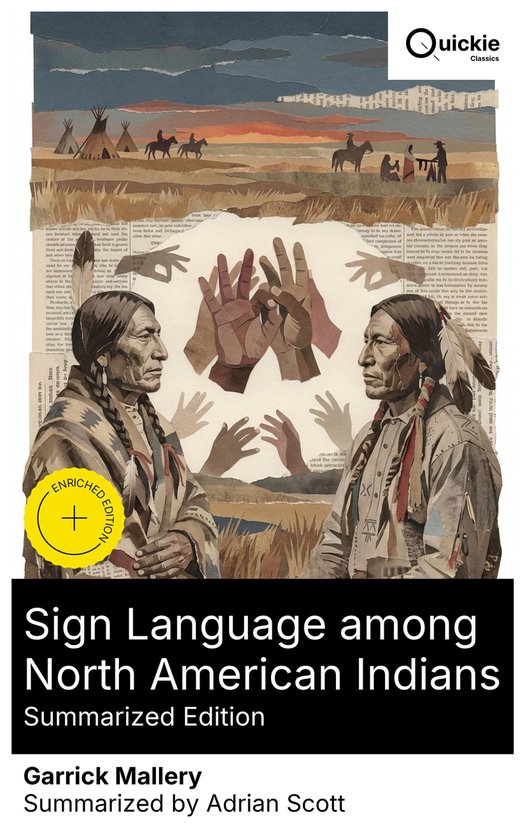
Sign Language among North American Indians (Summarized Editi ...
Garrick Mallery
- 10 januari 2026
- 8596547878667
Samenvatting:
Sign Language Among North American Indians offers a rigorous survey of the intertribal Plains gesture language and its regional variants. Mallery classifies hundreds of signs by handshape, movement, and position, notes frequent syntactic patterns and pragmatic settings, and provides cross-tribal equivalences. Placing the repertoire within the nineteenth‑century Plains economy of trade, diplomacy, hunting, and war, he also compares it with Deaf sign and classical manuals of gesture, exemplifying the documentary ethos of the Bureau of American Ethnology. A Civil War veteran and lawyer turned ethnologist, Garrick Mallery (1831–1894) worked under John Wesley Powell at the Smithsonian. Field time on the Upper Plains and an army-and-interpreter network gave him access to councils where sign bridged speech boundaries. Legal precision and comparative correspondence shaped his method. Scholars of anthropology, linguistics, Indigenous studies, and Deaf history will value this meticulous catalog and its lucid cross-cultural framing; general readers will find a vivid record of communication beyond speech. Read critically for period assumptions, but consult it as an essential, durable reference. Quickie Classics summarizes timeless works with precision, preserving the author's voice and keeping the prose clear, fast, and readable—distilled, never diluted. Enriched Edition extras: Introduction · Synopsis · Historical Context · Brief Analysis · 4 Reflection Q&As · Editorial Footnotes.