
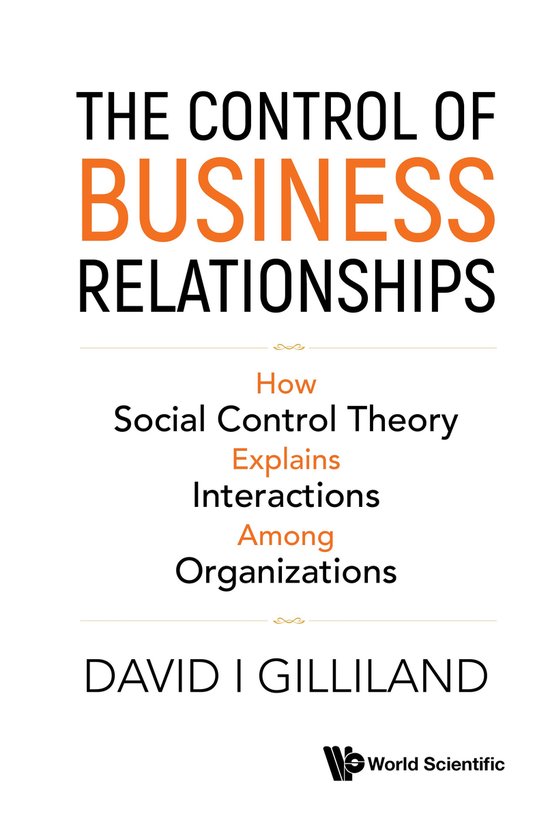
The Control of Business Relationships
David I Gilliland
- 14 maart 2024
- 9789811284892
Samenvatting:
How does social control theory explain the relationships between business firms and organizations? This book aims to answer that question. Providing a comprehensive organizing framework of control (1st, 2nd, and 3rd party control), this book focuses on informal and formal applications of control mechanisms such as contracts, monitoring mechanisms, incentives, and punishments. In doing so, it reviews existing control/governance theories such as transaction cost analysis, agency theory, power/dependence theory, contract theory, incentives theory and others. Social control theory is introduced as a meta-theory of governance and control. The derivation of control, the outcomes of control and, particularly, when and how control might be successful are discussed in detail.
The book hypothesizes that the control mode and mechanisms in use are a function of the cost of control to the controller based on its desire to manage the relationship and its outcomes, and the target of control's extent of agreement with the control processes in use. The various components of costs of control are identified and discussed. Drawing on interdisciplinary sources of information, it is a must-read for all who are interested in understanding the mechanisms of control and relationships underpinning business organizations.
Contents:
- About the Author
- Introduction
- Control
- Overview of the Control Framework
- The Modes and Mechanisms of Control
- The Self-Control System
- The Dyadic Control System
- The Third-Party Control System
- A General Hypothesis and the Costs of Control
- Control Structure
- Does Control Work?
- What Next?
- References
- Index
Readership: Graduate-level students and above.
Key Features:
- Uses an overarching meta-theory to explain control in an easy-to-understand fashion
- Written for an interdisciplinary market, taking information from marketing, management, accounting, sociology, psychology and other areas
- Applies a unique, comprehensive framework to studying control on many different levels: individual control (control of the self), dyadic control, and third party control
- Includes helpful figures and tables for easy understanding