
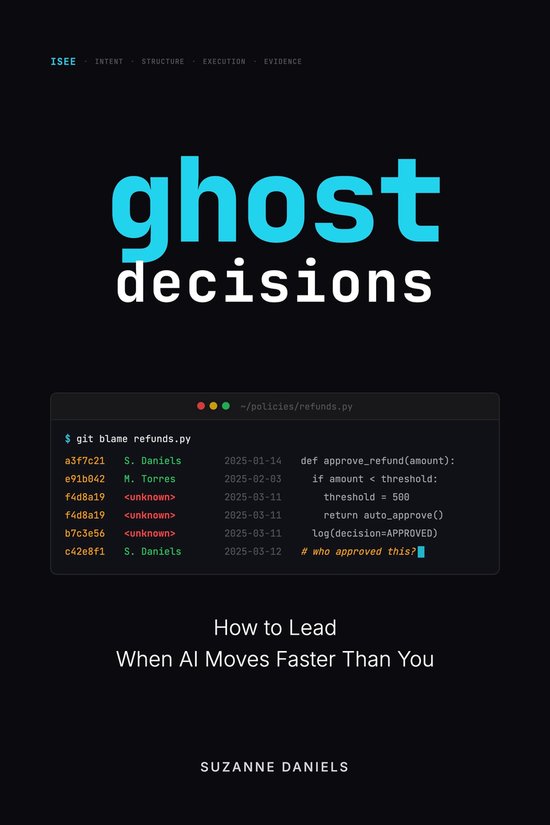
Ghost Decisions
Suzanne Daniels
- 11 juni 2026
- 1230010069714
Samenvatting:
Your agents ship while you sleep. Who owns the decisions they make?
Fourteen changes deployed overnight. Twelve from AI agents. All approved — by the structure instead of a person. The fix was correct. The process was followed. And at the morning sync, nobody could say who owned the decision.
This is the Agentile condition — and most organisations are already in it.
AI agents write code, merge pull requests, deploy to production, and respond to incidents at machine speed. Your operating model was built for a world where humans were in every loop. That world is over. The question is no longer whether to adopt AI agents. The question is who governs what they do — and what happens when the answer is "nobody, specifically.". Suzanne Daniels calls the decisions that emerge from this gap ghost decisions — changes that are correct, approved, deployed, and ownerless. Then she introduces the operating model that resolves them.
ISEE — Intent, Structure, Execution, Evidence
ISEE is a four-layer operating model for organisations where machines execute at speed and humans must govern at scale. Humans own the slow layers — strategic intent, codified structure. Machines run the fast ones —
continuous execution, real-time evidence. A spine translates between them: human judgement rendered once, enforced thousands of times per day.
The layers are not engineering-specific. They describe any organisation where decisions are made at multiple speeds and multiple scopes — from platform teams to regulated industries to post-merger integration.
Inside this book:
Ghost decisions — why your organisation is already making decisions nobody remembers authorising
The four layers— Intent, Structure, Execution, Evidence — and why the speed asymmetry between them is the design, not a flaw
The spine— why your platform offers a menu when it should be making the call, and what changes when structure replaces conversation
The EM crisis — five accountabilities hiding inside one role, and the three roles (Steward, Coach, Spine Author) that replace the composite before it burns people out
Rule of law — what happens when the people who held the knowledge leave, and why the spine must survive them
Governing the governors — separation of powers for platform teams, because good people are not a governance mechanism
The chrysalis — why transformation programmes fail, what a constitutional moment is, and how to create the conditions for one
What the framework doesn't know — six ways the metrics fail, open problems honestly named, and why that honesty matters
Who this book is for:
CTOs and VPs of Engineering navigating the shift from human-speed to machine-speed delivery. Platform leads building the infrastructure that governs AI agents. Engineering managers feeling the role fragment beneath them. Staff engineers and senior ICs who want to understand the organisational design around their technical work. CIOs and COOs seeing the same ghost decisions in operations, compliance, and service delivery. Transformation consultants and coaches looking for a framework they can teach, assess against, and adapt.
If your organisation uses AI agents in any part of its delivery pipeline, this book describes the operating model you need and don't yet have.
About the author:
Suzanne Daniels is a Technology leader, she works with CxOs and engineering leaders across EMEA on the fundamental shift in how software gets built. She has held roles spanning software engineering, architecture, engineering management, and fractional CTO work. She speaks at conferences on Agentic Software Development, AI adoption, and engineering leadership. She lives in the Netherlands.