
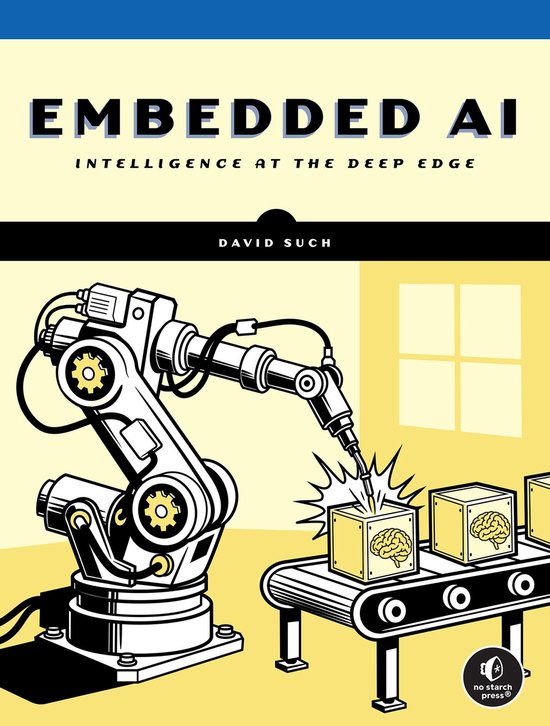
Embedded AI
David Such
- 27 oktober 2026
- 9781718504912
Samenvatting:
A project-driven guide to designing, training, and deploying artificial intelligence directly on embedded hardware, showing how to build intelligent, autonomous systems under real-world constraints.
You already know how to build embedded systems. Now it’s time to make them intelligent.
Adding AI to an embedded device takes more than training a model. You have to choose the right hardware, collect and prepare data, deploy models to resource-constrained devices, and integrate everything into a system that performs reliably.
Drawing on more than 30 years of embedded engineering experience, David Such takes you through the complete engineering process. You’ll work through more than 25 hands-on projects (complete with downloadable source code, schematics, PCB designs, and datasets); no machine learning experience required.
You’ll build:
- A wake-word detector that responds to your voice
- A real-time AI noise suppressor
- An AI-powered MIDI synthesizer that composes music
- A battery monitor that collects its own training data
- A person detector that runs a neural network on a camera board
Whether you’re an embedded developer adding AI to your products, a machine learning practitioner moving onto embedded hardware, or a maker ready to move beyond beginner projects, Embedded AI teaches you the engineering decisions behind every design. When the breadboard is flaky, the sensor data is noisy, or the tensor arena is too small, you’ll know how to fix it—and why.
Prerequisites
Most projects require an Arduino UNO or Raspberry Pi Pico; a few use specialized boards. You’ll also need to download some free software, including Python with TensorFlow, Arduino IDE, and Raspberry Pi Pico SDK.