
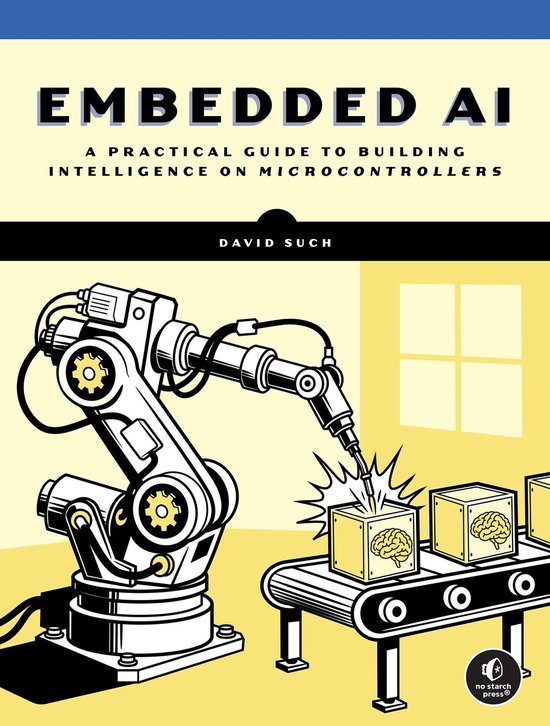
Embedded AI
David Such
- 06 oktober 2026
- 9781718504912
Samenvatting:
A project-driven guide to designing, training, and deploying artificial intelligence directly on embedded hardware, showing how to build intelligent, autonomous systems under real-world constraints.
If you already know your way around a microcontroller and want to add embedded AI to it—or you work in ML and you're ready to get your hands on real hardware—this book is for you. It covers the full embedded AI stack, from circuit design and custom PCB fabrication through sensor fusion and signal processing to on-device inference.
You'll learn how to wire the sensor, condition the signal, fuse IMU data using complementary filters, Madgwick, Mahony, and Kalman filters, deploy decision trees that run inside the sensor itself, and figure out why your tensor arena is the wrong size. Along the way, you'll tackle exploratory data analysis, model quantization, and the debugging realities that documentation never mentions—like what to do when the firmware uploader is fragile and your breadboard connections are dodgy.
Working on Arduino (UNO R3 and R4, Nano 33 BLE Sense, Nicla Vision, Nicla Voice), Raspberry Pi Pico 2, and ST evaluation boards, you'll build 25 complete projects, including:
- Signal generator using PIO and DMA on the Raspberry Pi Pico
- Battery state-of-charge prediction with Gaussian Process Regression
- Person detection using CNNs on the Nicla Vision
- Orientation detection using finite state machines running on-sensor
- Sensor fusion filter comparison across four IMUs with static angle testing
- Robot arm anomaly detection with decision trees on the ISM330BX machine learning core
- Real-time audio noise suppression using a GRU neural network on the Pico 2
- AI MIDI synthesizer with GAN-generated music, capacitive touch keyboard, VS1053b hardware synth, and procedural composition with Markov chains--all on custom PCBs
- Hot word detection on the Nicla Voice using Edge Impulse
- Battery monitor and logging shield with BQ24075 charger, fuel gauge, and programmable discharge load
Five custom PCBs are designed and built across the projects, with Gerber files and schematics provided. All code and hardware designs are open source under the MIT License.
This is embedded AI as a complete engineering discipline—sensors, circuits, signal processing, machine learning, and firmware—not a software shortcut.