
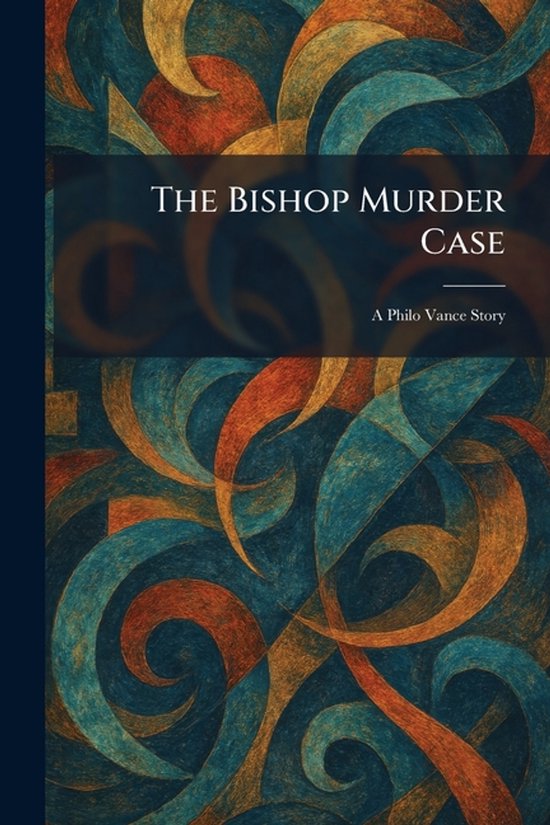
The Bishop Murder Case
- 14 februari 2026
- 9781025308265
Samenvatting:
"The Bishop Murder Case" is a quintessential Golden Age mystery featuring the sophisticated and erudite amateur detective Philo Vance. The narrative centers on a series of chilling murders in New York City, each meticulously staged to mirror a well-known nursery rhyme. The investigation begins when Joseph Cochrane Robin is found dead from an arrow wound, an eerie reenactment of "Who Killed Cock Robin?" As more victims fall and the cryptic signature of "The Bishop" is left behind, the local authorities find themselves outmatched by a killer who treats homicide as a grand intellectual game.Philo Vance must employ his vast knowledge of psychology, mathematics, and human nature to track down a brilliant but deranged mastermind. Set against a backdrop of 1920s high society, chess players, and academic rivalries, the work is celebrated for its intricate plotting and the cool, deductive reasoning of its protagonist. This novel remains a landmark in detective literature, offering a dark and atmospheric puzzle that challenges the reader to solve the mystery alongside one of fiction's most famous sleuths. "The Bishop Murder Case" showcases the height of the intellectual whodunit, emphasizing character study and complex clue-gathering over simple action.This work has been selected by scholars as being culturally important, and is part of the knowledge base of civilization as we know it. This work was reproduced from the original artifact, and remains as true to the original work as possible. Therefore, you may see the original copyright references, library stamps (as most of these works have been housed in our most important libraries around the world), and other notations in the work.This work is in the public domain in the United States of America, and possibly other nations. Within the United States, you may freely copy and distribute this work, as no entity (individual or corporate) has a copyright on the body of the work.As a reproduction of a historical artifact, this work may contain missing or blurred pages, poor pictures, errant marks, etc. Scholars believe, and we concur, that this work is important enough to be preserved, reproduced, and made generally available to the public. We appreciate your support of the preservation process, and thank you for being an important part of keeping this knowledge alive and relevant.