
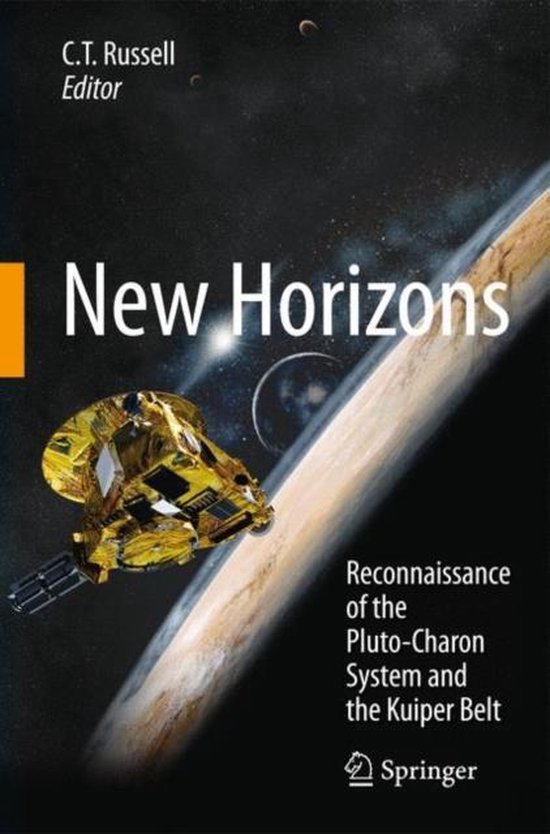
New Horizons
C. T. Russell
- 06 december 2010
- 9781441927989
Samenvatting:
Today explorers are going in new directions, not just east and west, north and south. They explore backward in time and upward in space. Arc- ology explores the shorter time scales, and geochemistry the longer time scales of geophy- cal events: asteroidal and cometary collisions, magnetic reversals, continental formation and more.
The New Horizons mission provides the first in situ reconnaissance of the Pluto-Charon System and the Kuiper belt, arguably the last frontier of solar system exploration. This book describes the mission, its objectives, expected results, and instruments in articles written by the scientists and engineers most closely involved. The New Horizons mission is expected to return unique observations and discoveries, which will revolutionize our understanding of the formation of the solar system.
This volume is aimed at researchers and graduate students active in planetary science and space exploration, and all other potential users of data obtained by the instruments on board the New Horizons mission.
New Horizons: Reconnaissance of the Pluto–Charon System and the Kuiper Belt C. T. Russell Originally published in the journal Space Science Reviews, Volume 140, Nos 1–4, 1–2. DOI: 10. 1007/s11214-008-9450-0 © Springer Science+Business Media B. V. 2008 Exploration is mankind’s imperative. Since the beginnings of civilization, men and women have not been content to build a wall around their settlements and stay within its con nes. They explored the land around them, climbed the mountains, and scanned the horizons. The boldest among them pushed exploration to the most distant frontiers of the planet. As a result, much of the Earth was inhabited well before the days of the renowned European - th th plorers of the 15 and 16 centuries. Exploration did not cease, after the circumnavigation of the globe; it continued to the present. Today explorers are going in new directions, not just east and west, north and south. They explore backward in time and upward in space. Arc- ology explores the shorter time scales, and geochemistry the longer time scales of geophy- cal events: asteroidal and cometary collisions, magnetic reversals, continental formation and more. However, on Earth we cannot go back inde nitely, for much of the evidence of the very earliest days has been lost.