
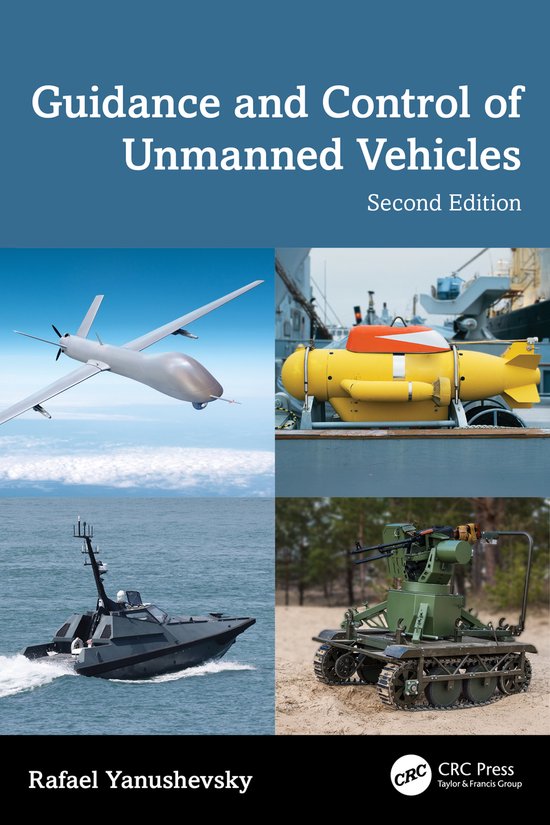
Guidance and Control of Unmanned Vehicles
Rafael Yanushevsky
- 31 maart 2026
- 9781041147411
Samenvatting:
Guidance and Control of Unmanned Vehicles demonstrates how the developed guidance laws for UAVs can be applied to a wide class of unmanned vehicles, including aerial, ground, water, and underwater vehicles. This new edition formulates an expanded guidance problem and guidance laws that can be applied to all unmanned vehicles.
Guidance and Control of Unmanned Vehicles demonstrates how the developed guidance laws can be applied to a wide class of unmanned vehicles, including aerial, ground, water, and underwater vehicles.
Drawing upon the author’s innovative approach and new research, this new edition presents a rigorous theory of guidance based on the parallel navigation rule and formulates an expanded guidance problem and guidance laws that can be applied to all unmanned vehicles. The book also discusses the obstacle avoidance problem for unmanned vehicles, and avoidance algorithms. Readers will learn how to choose optimal parameters of guidance laws based on the Lyapunov-Bellman approach. It also includes a new chapter on the role of unmanned vehicle operators.
This book will interest scientists, industry researchers, and practicing engineers working on the performance of various unmanned vehicles. It can serve as a basis for several graduate courses in the fields of electrial, mechanical, aerospace, and computer engineering.