
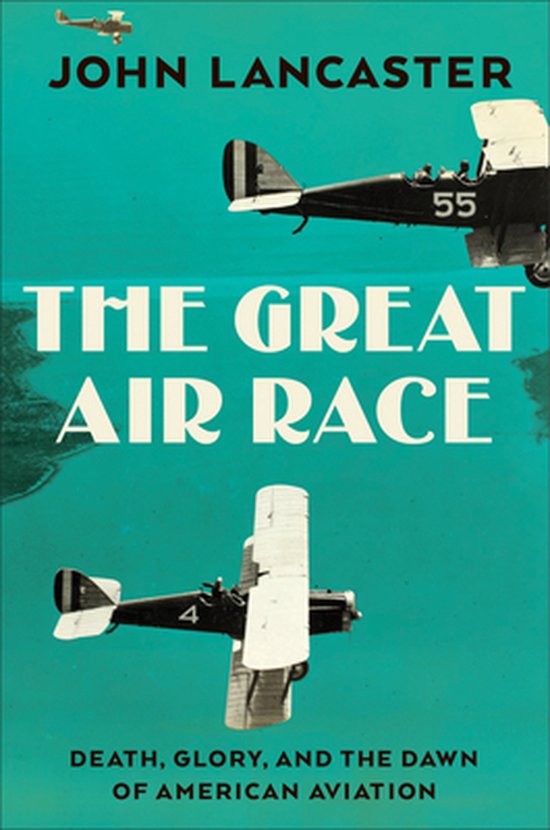
The Great Air Race
John Lancaster
- 15 november 2022
- 9781631496370
Samenvatting:
The untold, almost unbelievable, story of the daring pilots who risked their lives in an unprecedented air race in 1919—and put American aviation on the map.
“Few Americans remember today that, between World War I and World War II, air-racing was the country’s most popular form of public entertainment . . . this is more than the tale of those magnificent men and their flying machines. For contemporary readers, it is also a fable of how new technologies are introduced and spread.”
—Rinker Buck, New York Times best-selling author of Life on the Mississippi
“In The Great Air Race, John Lancaster unearths a forgotten and seminal saga in American aviation history . . . [and] vividly evokes the turbulent history of early competition among audacious men determined to fly round-trip cross-country at all costs.”
—Cherie Burns, author of? The Great Hurricane
“Combining a journalist’s storytelling skill with his own expertise as a pilot, John Lancaster puts you in the cockpit of this dangerous contest to prove the potential of airpower.
—Douglas Waller, author of A Question of Loyalty
“A virtually forgotten yet historically important air race at the dawn of commercial aviation is grippingly brought to life by John Lancaster.”
—Eric Jay Dolin, best-selling author of Rebels at Sea
“In narrating the story of the great 1919 air race, John Lancaster is also describing the birth of arguably the single most enduring technological breakthrough of the twentieth century, one that still wields enormous power over our daily lives and the fate of the world.”
—Glenn Frankel, Pulitzer Prize–winning journalist and author of Shooting Midnight Cowboy
Years before Charles Lindbergh’s flight from New York to Paris electrified the nation, a group of daredevil pilots, most of them veterans of the World War I, brought aviation to the masses by competing in the sensational transcontinental air race of 1919. The contest awakened Americans to the practical possibilities of flight, yet despite its significance, it has until now been all but forgotten. In The Great Air Race, journalist and amateur pilot John Lancaster finally reclaims this landmark event and the unheralded aviators who competed to be the fastest man in America. His thrilling chronicle opens with the race’s impresario, Brigadier General Billy Mitchell, who believed the nation’s future was in the skies. Mitchell’s contest—critics called it a stunt—was a risky undertaking, given that the DH-4s and Fokkers the contestants flew were almost comically ill-suited for long-distance travel: engines caught fire in flight; crude flight instruments were of little help in clouds and fog; and the brakeless planes were prone to nosing over on landing. Yet the aviators possessed an almost inhuman disregard for their own safety, braving blizzards and mechanical failure as they landed in remote cornfields or at the edges of cliffs. Among the most talented were Belvin “The Flying Parson” Maynard, whose dog, Trixie, shared the rear cockpit with his mechanic, and John Donaldson, a war hero who twice escaped German imprisonment. Jockeying reporters made much of their rivalries, and the crowds along the race’s route exploded, with everyday Americans eager to catch their first glimpse of airplanes and the mythic “birdmen” who flew them. The race was a test of endurance that many pilots didn’t finish: some dropped out from sheer exhaustion, while others, betrayed by their engines or their instincts, perished. For all its tragedy, Lancaster argues, the race galvanized the nation to embrace the technology of flight. A thrilling tale of men and their machines, The Great Air Race offers a new origin point for commercial aviation in the United States, even as it greatly expands our pantheon of aviation heroes.