
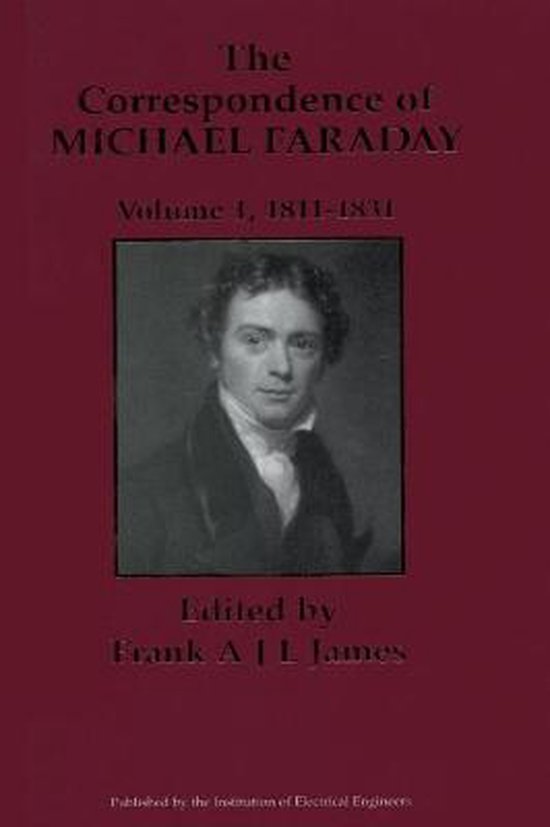
Correspondence Of Michael Faraday
Michael Faraday
- 01 juni 1991
- 9780863412486
Samenvatting:
Volume 1 covers Faraday's early years up to his discovery of electromagnetic induction in 1831. Other scientific and technical topics covered include Faraday's discovery of electromagnetic rotations (in 1821), the liquefaction of gases (in 1823) and the long series of experiments in the latter part of the 1820s to improve optical glass.
Michael Faraday (1791-1867) was one of the most important men of science in nineteenth century Britain. His discoveries of electro-magnetic rotations (1821), and electro-magnetic induction (1831) laid the foundations of the modern electrical industry. His discovery of the magneto-optical effect and of diamagnetism (1845) led him to formulate the field theory of electro-magnetism, which forms one of the cornerstones of modern physics.
These and a whole host of other fundamental discoveries in physics and chemistry, together with his lecturing at the Royal Institution, his work for the state, his religious beliefs, his lack of mathematical ability, make Faraday one of the most fascinating scientists ever.
All the aspects of his life and work are reflected in his correspondence. Appropriately, volume one, which covers the years 1811-1831, was published in the year of the bicentenary of his birth. It contains correspondence (previously unpublished) not only with contemporary men of science (such as Davy Ampére and Herschel) but also with major figures in many other areas of early nineteenth century society.
The Correspondence is a valuable resource for historians, philosophers and sociologists of science, as well as historians of the nineteenth century and the industrial revolution. It will also be of great interest to electrical engineers, physicists and chemists who want to know more about one of the most eminent figures in the history.