
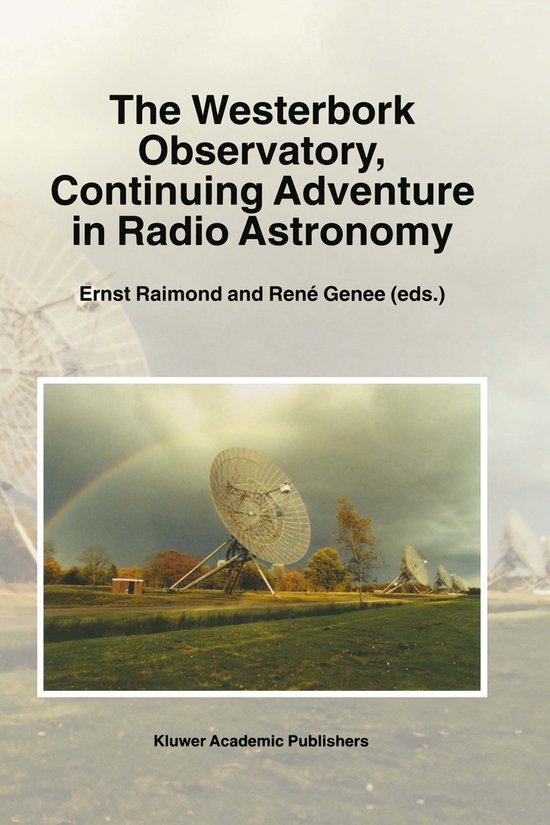
The Westerbork Observatory, Continuing Adventure in Radio As ...
Ernst Raimond
- 30 september 1996
- 9780792341505
Samenvatting:
A small country builds a world-class telescope in its backyard and lives happily ever after (or at least for a quarter century). Living happily in this context is a continuing record of discovery and as such also a continuing basis for se curing observing time on facilities in other countries and operating at other frequencies.
The impact of large radio telescopes on the progress of astronomical research in the past, present and future is the subject of twelve essays, of interest to both the layman and the professional astronomer. Current research in different fields and visions of what may be achieved with future observational possibilities are found next to contributions containing historical notes on Dutch radio astronomy and the scientific highlights of a quarter-century's work with the Westerbork Synthesis Radio Telescope. Major upgrades in progress will soon turn the WSRT into a more powerful and significantly more versatile instrument. Looking further ahead, plans for a new-generation telescope, a Square-Kilometer- Array, promise advances in many areas of astronomy, among them research on pulsars, on gas in the early universe and in cosmology.