
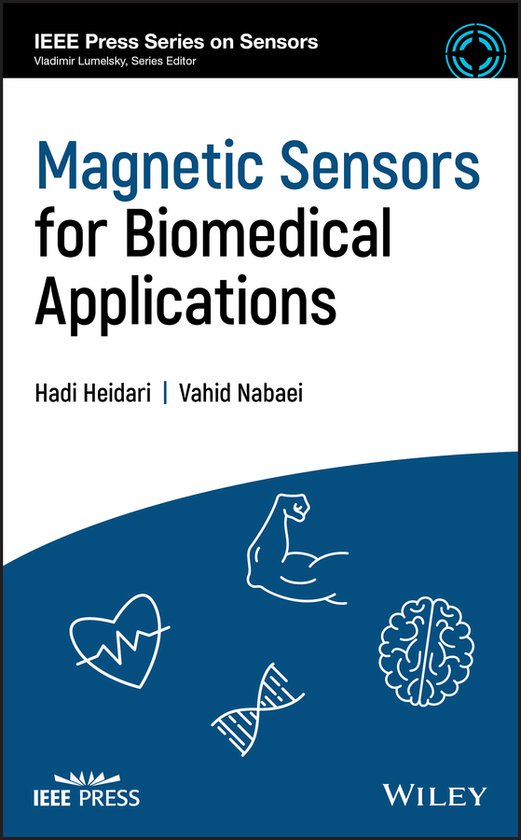
Magnetic Sensors for Biomedical Applications
Hadi Heidari
- 03 februari 2020
- 9781119552178
Samenvatting:
An important guide that reviews the basics of magnetic sensors for biomedical applications
Magnetic Sensors for Biomedical Applications offers a comprehensive review of various magnetic sensors ranging from miniaturized Hall-effect and magnetic devices to superconducting quantum. The authors explore the model and design strengths and weaknesses and discuss the competencies of different technology from an application-focused point of view based on required resolution and sensitivity.
The section on sensor materials examines promising materials whose properties have been used for sensing action and predicts future smart-materials that have the potential for sensing application. Next, the authors present classifications of sensors that are divided into different sub-types. They describe their working and highlight important applications that reveal the benefits and drawbacks of relevant designs. The book also contains information on the most recent developments in the field of each sensor type. This important book:
- Explains how solution methods complement each other, and offers information on their materials, design, computer aided modeling and simulation, optimization, and device fabrication
- Describes modeling, design, fabrication and application work challenges and solutions
Written for students in electrical and electronics engineering, physics, chemistry, biomedical engineering, and biology, Magnetic Sensors for Biomedical Applications offers a guide to the principles of biomagnetic sensors, recent developments, and reveals the impact of magnetic sensors on future non-invasive medical electronics.
An important guide that reviews the basics of magnetic biosensor modeling and simulation
Magnetic Sensors for Biomedical Applications offers a comprehensive review of magnetic biosensor modelling and simulation. The authors—noted experts on the topic—explore the model's strengths and weaknesses and discuss the competencies of different modelling software, including homemade and commercial (for example Multi-physics modelling software).
The section on sensor materials examines promising materials whose properties have been used for sensing action and predicts future smart-materials that have the potential for sensing application. Next, the authors present classifications of sensors that are divided into different sub-types. They describe their working and highlight important applications that reveal the benefits and drawbacks of relevant designs. The book also contains information on the most recent developments in the field of each sensor type. This important book:
- Provides an even treatment of the major foundations of magnetic biosensors
- Presents problem solution methods such as analytical and numerical
- Explains how solution methods complement each other, and offers information on their materials, design, computer aided modelling and simulation, optimization, and device fabrication
- Describes modeling work challenges and solutions
Written for students in electrical and electronics engineering, physics, chemistry, biomedical engineering, and biology, Magnetic Sensors for Biomedical Applications offers a guide to the principles of biomagnetic sensors, recent developments, and reveals the impact of sensor modelling and simulation on magnetic sensors.