
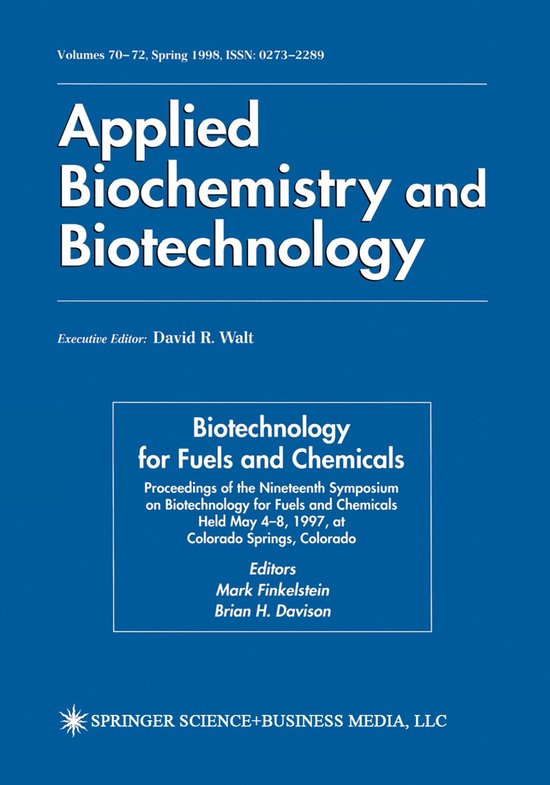
Biotechnology for Fuels and Chemicals
Mark Finkelstein
- 02 juni 1998
- 9780896036512
Samenvatting:
The ability to turn lignocellulosic materials into simple sugars offers great opportunities to generate cost-effective feed stocks to be used in biotechnological processes for the production of fuels and chemicals.
In Biotechnology for Fuels and Chemicals, based on the 19th Symposium, held in Colorado Springs, CO, May 4-8, 1997, leading researchers from academia, industry, and government present their new applications and cutting-edge research advances in the production of fuels and chemicals through biotechnology. The focus of the proceeding was on the utilization of renewable resources, particularly cellulosic biomass.
Biotechnology for Fuels and Chemicals covers a wide range of technical topics. Among the high points are innovative pretreatment processes that can turn lignocellulosic materials into simple sugars, the development of exciting new biocatalysts and microbes, new reactor designs, and inventive conversion processes. Also discussed are a number of microbes and plants that have been genetically modified to perform novel bioconversions to produce enzymes and key chemical intermediates. The meeting clearly demonstrated that biotechnology and bioprocessing can make it possible to convert cellulosic biomass into fuels and chemicals in a commercially attractive fashion.
MARK FINKELSTEIN National Renewable Energy Laboratory BRIAN H. DAVISON Oak Ridge National Laboratory The proceedings of the 19th symposium on Biotechnologyfor Fuels and Chemicals, held in Colorado Springs, Colorado, May 4-8, 1997, had over 200 attendees. This meeting continues to provide a unique forum for the presentation of new applications and recent research advances in the production of fuels and chemicals through biotech nology. The utilization of renewable resources, and in particular cellulosic biomass, has broad implications in today's world of green house gases, global warming, ozone layers, climate change, energy sustainability, and carbon emissions. It also has relevance to the chemical industry's continuing need to both lower current chemi cal production costs and produce novel chemicals. Biotechnology and bioprocessing are now making it possible to convert this bio mass to fuels and chemicals in a commercially attractive fashion. The 19th Symposium captures a wide range of technical topics from an academic, industrial, or government perspective. A vari ety of biomass feedstocks are discussed in Session 1, along with several updated and innovative pretreatment processing approaches. The ability to turn lignocellulosic materials into simple sugars offers great opportunities to generate cost-effective feed stocks to be used in biotechnological processes for the production of fuels and chemicals. Through the advent of genetic engineering, the development of a series of exciting new biocatalysts and microbes were presented in Session 2.