
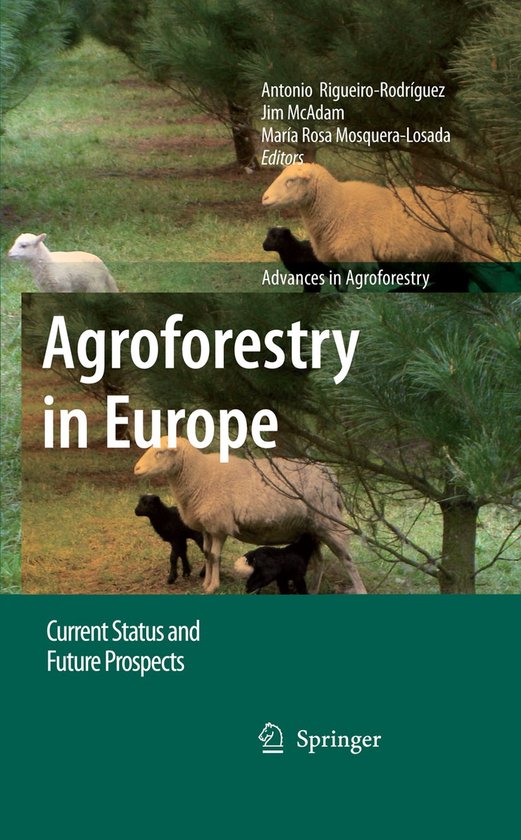
Agroforestry in Europe
Antonio Rigueiro-Rodriguez
- 24 oktober 2008
- 9781402082719
Samenvatting:
Agroforestry has come of age during the past three decades. While it is true that the tropics, compared to the temperate regions, have a wider array of agroforestry systems and hold greater promise for potential agroforestry interventions, it is also true that agroforestry has several opportunities in the temperate regions too.
While recent EU Rural Development policy clearly recognises the economic, ecological, and social advantages of agroforestry systems, to date the implementation of such systems remains poor throughout most of Europe. In light of this, this collection of peer-reviewed papers brings together some of the most important current research in European agroforestry, and evaluates the current scope and future potential of agroforestry across the EU.
While the majority of Europe’s agroforestry practices are currently focused in the Mediterranean, this volume draws together examples from a wide range of countries – including Greece, Spain, the UK, Hungary, Germany, Italy, the Netherlands, Switzerland, France and Slovenia. The book also covers a range of agroforestry types, including silvopastoralism – Europe’s predominant form of agroforestry – as well as alley cropping, forest farming, silvoarable systems and the use of trees for shelter. Through these examples the book also discusses the potential roles for these traditional land management systems in addressing both environmental issues such as water quality, biodiversity conservation, desertification, ecosystem services and socioeconomic issues such as rural population stabilization.
Augmented by detailed reviews of the main elements of European agroforestry and the issues that face it, this timely collection of research papers provides a valuable reference both for advanced students and researchers interested in a wide range of issues around land use, rural development, natural resource management, landscape ecology, and conservation across Europe, and for the agroforestry community – including research and extension organizations – worldwide.
While recent EU Rural Development policy clearly recognises the economic, ecological, and social advantages of agroforestry systems, to date the implementation of such systems remains poor throughout most of Europe. In light of this, this collection of peer-reviewed papers brings together some of the most important current research in European agroforestry, and evaluates the current scope and future potential of agroforestry across the EU. While the majority of Europe's agroforestry practices are currently focused in the Mediterranean, this volume draws together examples from a wide range of countries -- including Greece, Spain, the UK, Hungary, Germany, Italy, The Netherlands, Switzerland, France and Slovenia. The book also covers a range of agroforestry types, including silvopastoralism -- Europe's predominant form of agroforestry -- as well as alley cropping, forest farming, silvoarable systems and the use of trees for shelter.Through these examples the book also discusses the potential roles for these traditional land management systems in addressing both environmental issues such as water quality, biodiversity conservation, desertification, ecosystem services and socioeconomic issues such as rural population stabilization. Augmented by detailed reviews of the main elements of European agroforestry and the issues that face it, this timely collection of research papers provides a valuable reference both for advanced students and researchers interested in a wide range of issues around land use, rural development, natural resource management, landscape ecology, and conservation across Europe, and for the agroforestry community -- including research and extension organizations -- worldwide.