
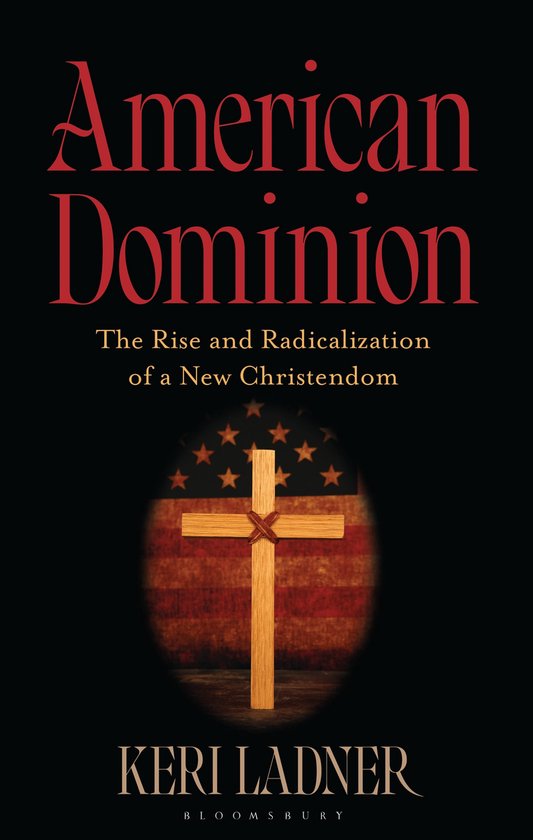
American Dominion
Keri Ladner
- 16 april 2026
- 9798216275763
Samenvatting:
American Dominion explains how strains of conservative evangelicalism coalesced into dominionism—an ideology that has influenced modern American politics and Trump’s inner circle. Tracing it from early Pentecostal revivals to its intrusion in our institutions, Ladner reveals how this movement has reshaped the landscape of our politics and culture.
How did a predictable “family values” evangelical politics become the engine of an anti-democratic movement with unprecedented access to American power? Keri Ladner traces that transformation through the rise of dominionism—a radical strain of evangelical Christianity that frames political authority as a biblical mandate and treats democracy less as a safeguard than as an obstacle to overcome.
Ladner argues that the alliance between Donald Trump and the evangelical right cannot be explained by political expediency alone. Dominionist pastors were among Trump’s earliest allies in the 2016 Republican primaries, and after his 2024 election the movement has gained extraordinary influence within the party and the state, including direct proximity to national leaders at the highest levels. Rooted in an intense, literalized reading of Scripture, dominionism is animated by spiritual warfare: demons are not metaphors but actors, and demonization becomes both a theology and a tool of political mobilization. In this worldview, conspiracy cultures such as QAnon find ready spiritual reinforcement, deepening polarization and accelerating radicalization within the modern Republican coalition.
Moving from the early twentieth-century Pentecostal-charismatic revival movement to today’s networked megachurches, Ladner shows how a once-obscure religious fringe built durable institutions and mass appeal through dramatic healing revivals, disciplined teaching, and a steady drumbeat of “chosen nation” rhetoric. She maps the formation of a religious counterculture—often presented as conventional conservatism—shaped by curricula that traveled from homeschooling into wider educational spaces. The result is a vibrant, fast-growing religious movement that promises spiritual power and national renewal, even as it places America’s democratic norms under increasing strain.