
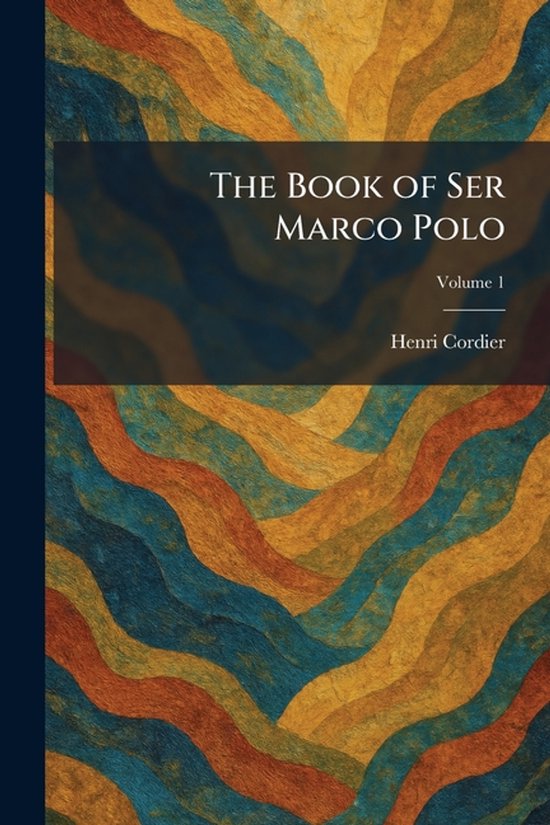
The Book of Ser Marco Polo
Henri Cordier
- 14 februari 2026
- 9781025317403
Samenvatting:
"The Book of Ser Marco Polo" stands as one of the most influential travelogues in world literature, documenting the extraordinary journey of the Venetian merchant across the Silk Road to the court of the Great Khan. This first volume of the celebrated Henri Cordier edition provides a comprehensive and deeply annotated exploration of Polo's observations through 13th-century Asia, offering readers a window into the diverse cultures, geographies, and political landscapes of the Mongol Empire.The narrative captures the awe and wonder of a European traveler encountering the advanced civilizations of the East. From the bustling trade centers of Persia to the opulence of Kublai Khan's court, the work details the social customs, religions, and natural resources of regions previously unknown to the Western world. Cordier's scholarly additions enrich the text, providing historical context and geographical clarifications that bridge the gap between medieval legend and modern history.As a foundational text for geography and cross-cultural studies, this work remains essential for those interested in the history of exploration, medieval commerce, and the enduring legacy of the Silk Road. It is not merely a record of travel, but a monumental ethnographic study that reshaped European perceptions of the globe.This work has been selected by scholars as being culturally important, and is part of the knowledge base of civilization as we know it. This work was reproduced from the original artifact, and remains as true to the original work as possible. Therefore, you may see the original copyright references, library stamps (as most of these works have been housed in our most important libraries around the world), and other notations in the work.This work is in the public domain in the United States of America, and possibly other nations. Within the United States, you may freely copy and distribute this work, as no entity (individual or corporate) has a copyright on the body of the work.As a reproduction of a historical artifact, this work may contain missing or blurred pages, poor pictures, errant marks, etc. Scholars believe, and we concur, that this work is important enough to be preserved, reproduced, and made generally available to the public. We appreciate your support of the preservation process, and thank you for being an important part of keeping this knowledge alive and relevant.