
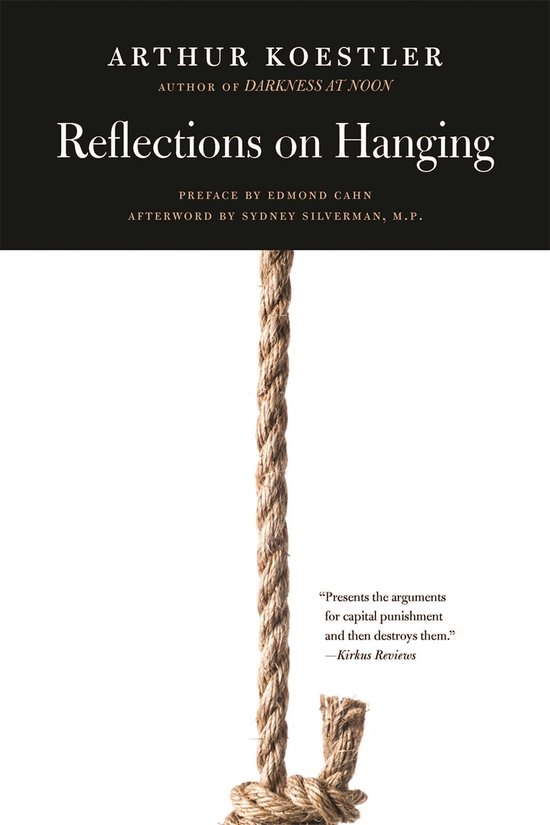
Reflections on Hanging
Arthur Koestler
- 15 maart 2019
- 9780820355351
Samenvatting:
A searing indictment of capital punishment, inspired by its author's own time in the shadow of a firing squad. During the Spanish Civil War, Arthur Koestler was held by the Franco regime as a political prisoner, and condemned to death. He was freed, but only after months of witnessing the fates of less-fortunate inmates.
Reflections on Hanging is a searing indictment of capital punishment, inspired by its author’s own time in the shadow of a firing squad. During the Spanish Civil War, Arthur Koestler was held by the Franco regime as a political prisoner, and condemned to death. He was freed, but only after months of witnessing the fates of less-fortunate inmates. That experience informs every page of the book, which was first published in England in 1956, and followed in 1957 by this American edition.
As Koestler ranges across the history of capital punishment in Britain (with a focus on hanging), he looks at notable cases and rulings, and portrays politicians, judges, lawyers, scholars, clergymen, doctors, police, jailers, prisoners, and others involved in the long debate over the justness and effectiveness of the death penalty.
In Britain, Reflections on Hanging was part of a concerted, ultimately successful effort to abolish the death penalty. At that time, in the forty-eight United States, capital punishment was sanctioned in forty-two of them, with hanging still practiced in five. This edition includes a preface and afterword written especially for the 1957 American edition. The preface makes the book relevant to readers in the U.S.; the afterword overviews the modern-day history of abolitionist legislation in the British Parliament.
Reflections on Hanging is relentless, biting, and unsparing in its details of botched and unjust executions. It is a classic work of advocacy for some of society’s most defenseless members, a critique of capital punishment that is still widely cited, and an enduring work that presaged such contemporary problems as the sensationalism of crime, the wrongful condemnation of the innocent and mentally ill, the callousness of penal systems, and the use of fear to control a citizenry.