
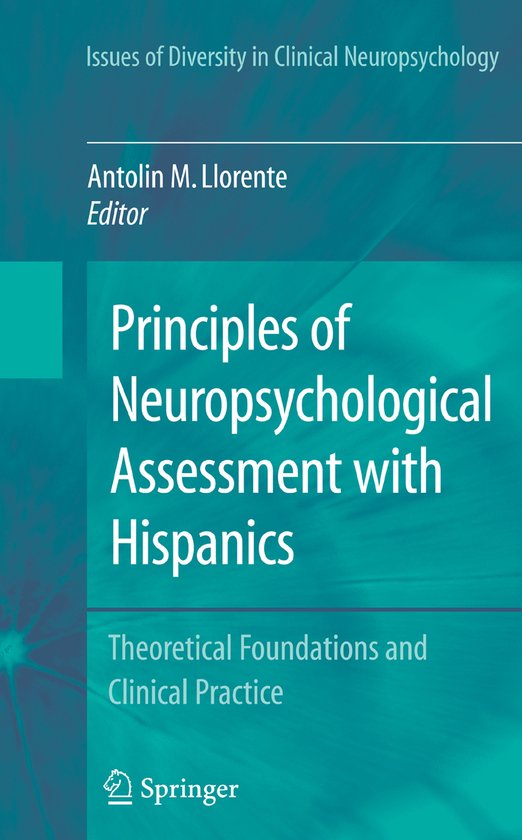
Principles of Neuropsychological Assessment with Hispanics
Antolin M. Llorente
- 24 november 2010
- 9781441924544
Samenvatting:
This volume will be the first volume of this new series that explores diversity, culture and ethnicity and their impact on neurological functioning.
It will provide a forum in which to examine and explore the influences of culture on brain-behavior relationships from theoretical and applied viewpoints.
The inaugural volume in the Issues of Diversity in Clinical Neuropsychology series, Principles of Neuropsychological Assessment with Hispanics sheds needed light on challenges specific to assessing members of this growing, diverse population. Beginning with evidence-based findings revealing intricate nonlinear relationships between culture and the brain, Antolin M. Llorente and a team of eight experts explore finely nuanced constructs of culture, ethnicity, race, and language among Hispanics in neurobehavioral and neurocognitive terms. The authors ably balance theory, research, and practical applications, and give ample space to ethical issues in the assessment of Latinos, indicating the ongoing need for bias-free procedures so that evaluations—and the treatment interventions that they generate—are accurate and valid.
In-depth coverage of:
- Acculturation and assimilation
-
- Language, bilingualism, and multilingualism
-
- Cultural and ethnic identity
-
- Patterns of migration and immigration
as they affect core practical areas, including:
- Competence
-
- Minimal standards
-
- Test development and norms
-
- Psychopathology and rehabilitation.
Synthesizing the state of an evolving field and a highly heterogeneous subject group, this book is bound to appeal to a wide range of mental health professionals, including clinical neuropsychologists, clinical and educational psychologists, psychiatrists, social workers and other mental health professionals.