
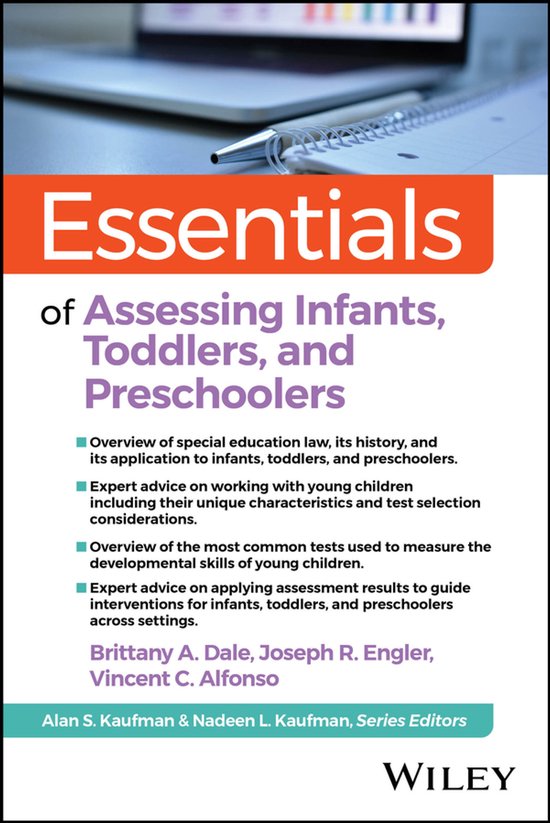
Essentials of Psychological Assessment- Essentials of Assess ...
Brittany A. Dale
- 25 maart 2025
- 9781394152070
Samenvatting:
A concise and practical reference to techniques and issues in the assessment of children ages 0-5 years
Early childhood assessment is important for appropriately guiding intervention and supporting wellbeing in young children. Essentials of Assessing Infants, Toddlers, and Preschoolers covers the concepts and practices that professionals need to know in order to perform effective assessments and help translate them into targeted interventions.
Inside, readers will learn how assessing young children differs from assessing other populations. Considerations for assessment of culturally and linguistically diverse children are also included. The authors consider the impact of recent legislation, including new programs available under the Every Student Succeeds Act (ESSA). This book also covers the available assessments for various developmental domains and special populations.
As with all volumes in the popular Essentials of Psychological Assessment Series, this book contains visual cues that highlight key points, along with step-by-step guidelines that make this an immediately useful resource. Theory and research are woven into the material, but always with an eye toward practical application. Beginning and seasoned practitioners, as well as those supervising students, will find value in this comprehensive guide to early childhood assessment.
A practitioner-oriented guide to the most important assessments and evaluation techniques for children ages 0-5
Many assessment professionals leave their graduate education programs without any formal training in assessing infants and young children. Although there are assessment textbooks covering subsets of this age range, Essentials of Assessing Infants, Toddlers, and Pre-Schoolers is uniquely designed for busy practitioners, and it covers the full range of assessments for 0-5 years old.
With medical advances and new treatments, there is a higher prevalence of children with complex medical and psychological needs. Additionally, changing educational policies often affect assessment practices. Assessment professionals must have current information to effectively assess young children and assist in planning interventions. As with all volumes in the Essentials of Psychological Assessment series, this book consists of concise chapters featuring callout boxes highlighting key concepts, easy-to-learn bullet points, and extensive illustrative material, as well as test questions that help you gauge and reinforce your grasp of the information covered.
- Understand the issues unique to assessing children aged 0-5 years
- Get expert advice on assessing children with extremely early preterm birth, genetic conditions, and other unique situations
- Consider the future directions in the assessment of infants, toddlers, and preschoolers
- Quickly and easily locate pertinent information and access resources and tools to aid in performing professional duties
This straightforward manual includes thorough coverage on how assessment results guide effective interventions. Essentials of Assessing Infants, Toddlers, and Pre-Schoolers is a valuable addition to the libraries of developmental practitioners, school and clinical psychologists, pediatricians, speech-language pathologists, and others responsible for the assessment of very young children.