
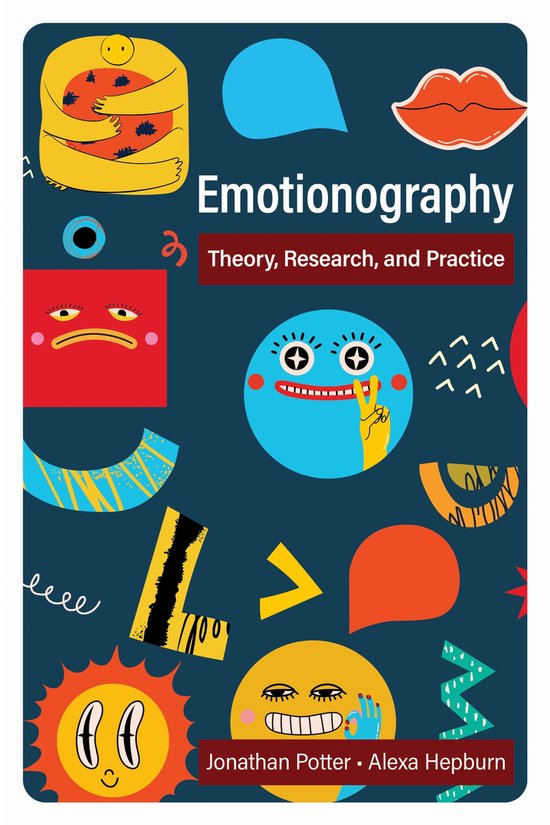
Emotionography
Jonathan Potter
- 29 mei 2026
- 9781433842702
Samenvatting:
Explore emotion as it unfolds in everyday interactions rather than in controlled experiments. The method captures subtle expressions and responses through detailed case examples, revealing how natural exchanges shape behavior while suggesting refined ways to enhance clinical practice and analysis.
How does emotion arise in everyday settings? How can it be studied in the real world?
In this book, authors Jonathan Potter and Alexa Hepburn offer their distinctive approach to the study of emotion. Emotionography explores emotion not through scales, experiments, or interviews, but as it actually occurs in natural interactions. Drawing on discursive psychology and conversation analysis, the authors' detailed analytic toolkit for representing talk, timing, and conduct makes visible how emotion is displayed, oriented to, and managed moment by moment. Step-by-step case examples show how crying and upset, laughter, and anger can be understood from an emotionographic perspective.
Emotion is live, consequential, and interactional, and it can be studied with a level of accuracy that also has practical bite. Emotionography shows how the ways people display and describe feelings shape what others do next, including how they respond, align, resist, comfort, escalate, or redirect. That matters in everyday life, and it matters in high-stakes settings such as helplines, emergency calls, healthcare, and counselling. Emotionography offers practitioners a way to refine how they respond in real time, and offers researchers a rigorous analytic alternative to treating emotion as a private inner state.