
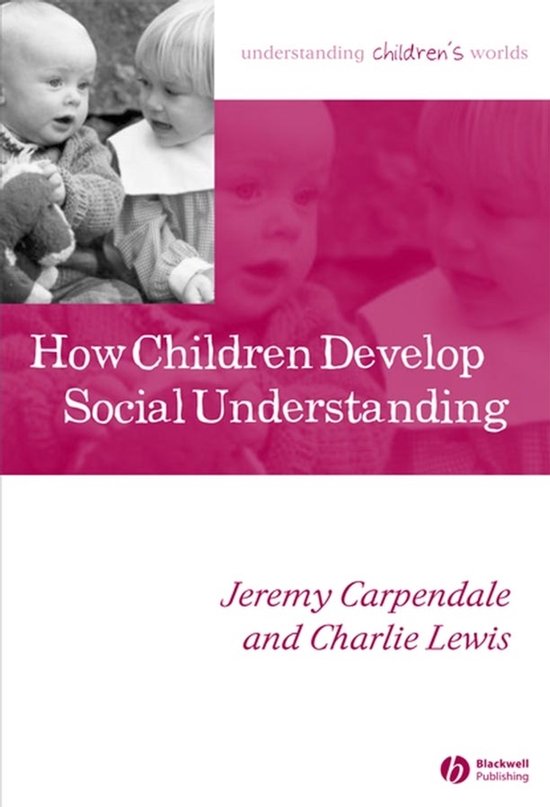
How Children Develop Social Understanding
Jeremy Carpendale
- 15 maart 2006
- 9781405105507
Samenvatting:
* A critical review of research into how children come to understand the social world. * Addresses a broad range of issues in children's "theories of mind". * Takes an integrated approach to the development of children's social understanding.
This book critically reviews research on the fascinating problem of how children come to understand the social world, an area often known as children's “theories of mind.” It will be of interest to a wide variety of readers because the issue of how children begin their entry into the social world is of such essential importance in child development.
The authors take an integrated view of the development of children’s social understanding, bringing out the connections between mental state understanding and their understanding of language, social skills, morality and emotions. A focus on language is central to their approach, since they propose that language both reflects understanding and facilitates its further development.
At the same time, the authors situate their own arguments and interpretations in a historical and theoretical context, discussing them not only in relation to current research and theory on the development of children's social understanding, but also in relation to more general theories of development by Piaget and Vygotsky and, for example, the philosophical work of Wittgenstein.
This book provides a critical review of research into how children come to understand the social world, an area often known as children's "theories of mind".
- Takes an integrated approach to the development of children's social understanding
- Brings out the connections between mental state understanding and children's understanding of language, social skills, morality and emotions.
Sets research within a historical and theoretical context - Contributes unique insights and perspectives, particularly in its discussions of Piaget and Vygotsky, and in its Wittgensteinian focus on the role of language.