
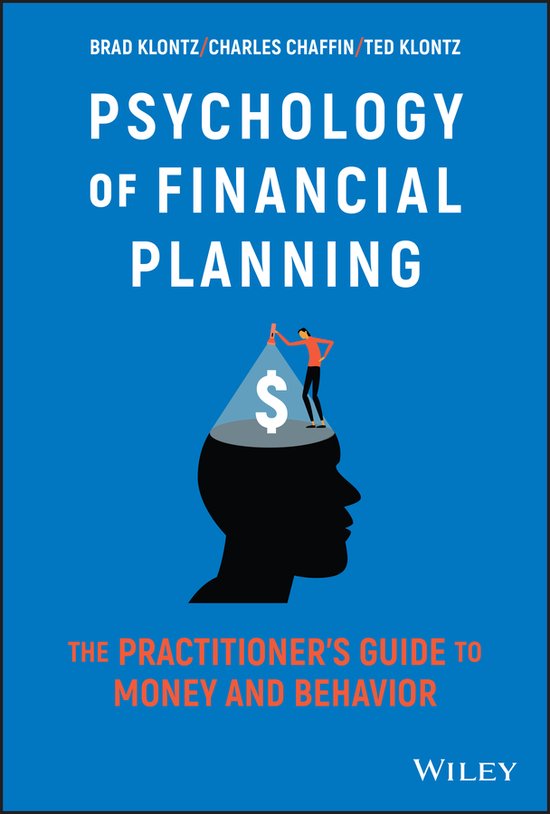
Psychology of Financial Planning
Brad Klontz
- 15 september 2022
- 9781119983729
Samenvatting:
UNCOVER WHAT MOTIVATES YOUR FINANCIAL PLANNING CLIENTS
Psychology of Financial Planning: The Practitioner’s Guide to Money and Behavior offers financial planners a holistic and insightful handbook to getting into the minds and hearts of their clients to help them achieve their financial goals. In the book, you’ll learn to facilitate both subtle and dramatic behavior changes by asking the right questions in the right way and taking your clients’ backgrounds and personal histories into account.
The authors dive deep into five key areas of financial psychology with outsized influences on how we interact with money and deliver contexts, tools, and solutions that address counterproductive financial behaviors, flashpoints, beliefs, triggers, and cognitive biases. The book incorporates all of the required learning objectives for individuals pursuing a career in financial planning.
Some of the key topic areas include:
- Understanding your client’s financial psychology,
- Getting the client to take action,
- Multicultural competence in financial planning,
- Principles of effective communication,
- Client and planner attitudes, values, biases,
- Behavioral finance in financial planning practice,
- Sources of money conflict,
- Principles of counseling in financial planning,
- Helping clients navigate crisis events.
A can’t-miss roadmap to improving your ability to successfully advise clients, Psychology of Financial Planning: The Practitioner’s Guide to Money and Behavior deserves a place on the bookshelves of financial planners everywhere.
Psychology of Financial Planning: The Practitioner’s Guide to Money and Behavior
In PSYCHOLOGY OF FINANCIAL PLANNING: The Practitioner’s Guide to Money and Behavior, distinguished authors Drs. Brad Klontz, CFP®, Charles Chaffin, and Ted Klontz deliver a comprehensive overview of the psychological factors that impact the financial planning client.
Designed for both professional and academic audiences, PSYCHOLOGY OF FINANCIAL PLANNING is written for those with 30 years in practice as well as those just beginning their journey.
With a focus on how psychology can be applied to real-world financial planning scenarios, PSYCHOLOGY OF FINANCIAL PLANNING provides a much-needed toolbox for practicing financial planners who know that understanding their client’s psychology is critical to their ability to be effective.
The PSYCHOLOGY OF FINANCIAL PLANNING is also a much-needed resource for academic institutions who now need to educate their students in the CFP Board’s newest category of learning objectives: psychology of financial planning.
Topics include:
- Why we are bad with money
- Client and planner attitudes, values, & biases
- Financial flashpoints, money scripts, and financial behaviors
- Behavioral finance
- Sources of money conflict
- Principles of counseling
- Multicultural competence in financial planning
- General principles of effective communication
- Helping clients navigate crisis events
- Assessment in financial planning
- Ethical considerations in the psychology of financial planning
- Getting clients to take action
- Integrating financial psychology into the financial planning process
PSYCHOLOGY OF FINANCIAL PLANNING goes beyond just theory to show how practitioners can use psychology to better serve their clients. The accompanying workbook provides exercises, scripts, and workshop activities for firms and practitioners who are dedicated to engaging and implementing the content in meaningful ways.