
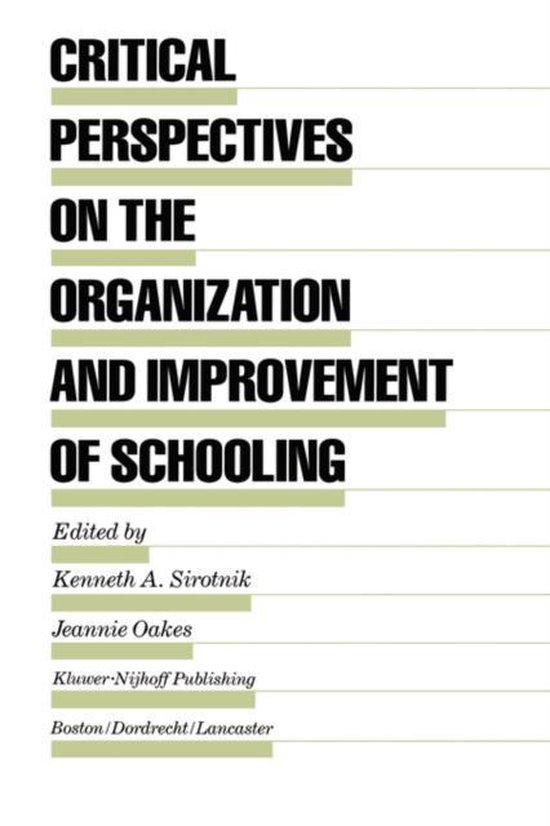
Critical Perspectives on the Organization and Improvement of ... - cover

Critical Perspectives on the Organization and Improvement of ...

Kenneth A. Sirotnik

  • 30 september 1986
  • 9780898382129
Wil ik lezen
  • Wil ik lezen
  • Aan het lezen
  • Gelezen
  • Verwijderen

Samenvatting:

This is the case, in our view, for one crucial reason: Both the more quantitative, empirical-analytic and qualitative, interpretive traditions share a fundamental epistemological commitment: they both eschew ideology and human interests as explicit components in their paradigms of inquiry.


Major "paradigm shifts"-replacing one "world view" with another­ regarding what constitutes appropriate knowledge do not happen over­ night. Centuries usually intervene in the process. Even minor shifts­ admitting alternative world views into the domain of legitimate knowledge­ producing theory and practice-require decades of controversy, especially, it seems to us, in the field of education. It has only been in the last 20 years or so that the educational research community has begun to accept the "scientific" credibility of the qualitative approaches to inquiry such as participant observation, case study, ethnogra­ phy, and the like. In fact, these methods, with their long and distinguished philosophical traditions in phenomenology, have really only come into their own within the last decade. The critical perspective on generating and evaluating knowledge and practice-what this book is mostly about-is in many ways a radical depar­ ture from both the more traditional quantitative and qualitative perspec­ tives. The traditional approaches, in fact, are far more similar to one another than they are to the critical perspective. This is the case, in our view, for one crucial reason: Both the more quantitative, empirical-analytic and qualitative, interpretive traditions share a fundamental epistemological commitment: they both eschew ideology and human interests as explicit components in their paradigms of inquiry. Ideology and human interests, however, are the "bread and butter" of a critical approach to inquiry.

We gebruiken cookies om er zeker van te zijn dat je onze website zo goed mogelijk beleeft. Als je deze website blijft gebruiken gaan we ervan uit dat je dat goed vindt. Ok