
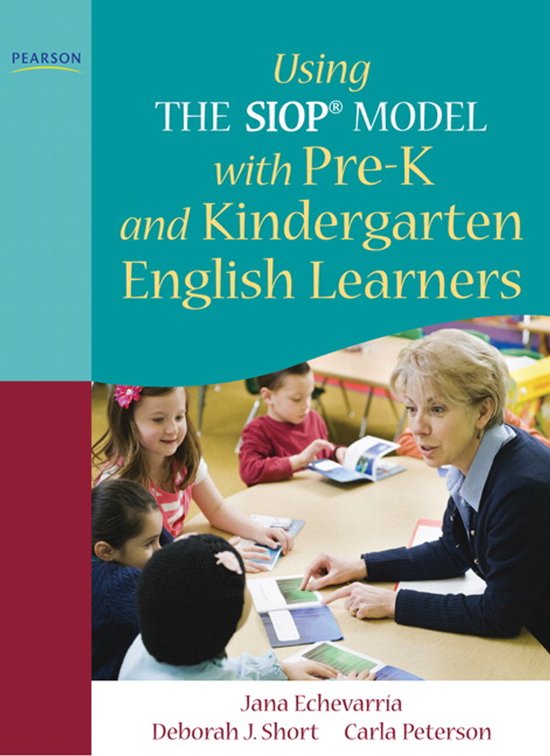
Using the SIOP Model with Pre-K and Kindergarten English Lea ...
Jana Echevarria
- 12 juli 2011
- 9780137085231
Samenvatting:
Jana Echevarría - Deborah J. Short
Using the SIOP® Model with Pre-K and Kindergarten English Learners
Based on the widely used resource, Making Content Comprehensible for English Learners: The SIOP® Model, which includes all grade levels, this book is tailored to the specific needs of pre-K and kindergarten children and their teachers, as teachers implement high-quality sheltered lesson planning, delivery, and assessment.
Designed for early childhood teachers and administrators, Using the SIOP® Model with Pre-K and Kindergarten English Learners describes the young English learner, current trends in early childhood education, and the fundamentals of language development. Focusing on implementation, the book includes a sample lesson plan, versions of the SIOP® protocol, and descriptions of how sample programs have used the SIOP® Model to provide an optimal learning environment for their young students. Chapters explore the SIOP® model, key components, and the research that explains why the model works.
What Educators Are Saying...
"The authors have a comprehensive grasp of early childhood "techniques" and have refashioned the SIOP® Model to this age group with lots of examples and detail. This book is very appealing and should be a welcome resource to early childhood educators."
–Joseph E. Leaf, ESL Coordinator, Norristown Area School District, Norristown, PA
Take a Glimpse Inside:
- Shows how to create an effective and developmentally appropriate instructional setting for young English learners.
- Features an overview of the SIOP ® Model and explains its research support and application to early childhood programs.
- Describes the young English learner, current demographic trends, and the fundamentals of language development.
- Presents a complete review of the eight components of the SIOP ® Model and how to implement them in lesson planning and delivery with young English learners.
- Provides a sample lesson plan and highlights three sample programs.
- Includes a comprehensive version of the SIOP ® protocol and an abbreviated version to help educators observe lessons, provide feedback, and support other teachers.
This new addition to the best-selling SIOP® Model series shows how to use the SIOP® Model with pre-K and kindergarten English learners so they can fully participate in all aspects of early schooling.
Understand the young English learner and language development, learn all eight components of the SIOP Model (lesson preparation, building background, comprehensible input and strategies, interaction and lesson delivery, practice & application and review & assessment), and see how other programs have used the SIOP Model to create an optimal learning environment for their young students.
- Focuses on preschool-aged children and kindergarteners—and shows how to create an effective and developmentally appropriate instructional setting for these young English learners.
- Provides an overview of the SIOP Model—and explains its research support and application to early childhood programs.
- Describes the young English learner, current demographic trends and the fundamentals of language development early in the book—to provide a context for later material (Chapters 2 and 3).
- Devotes four chapters to the eight components of the SIOP Model—so educators learn how to use lesson preparation, building background, comprehensible input and strategies, interaction and lesson delivery, practice & application and review & assessment with their young English learners (Chapters 4-7).
- Provides a sample lesson plan and highlights three sample programs—so educators can see how to implement the framework in different settings and circumstances.
- Includes a comprehensive version of the SIOP protocol and an abbreviated version—so educators learn how to use the tool to observe lessons, provide feedback, and support other teachers (Chapter 9 and Appendix A).