
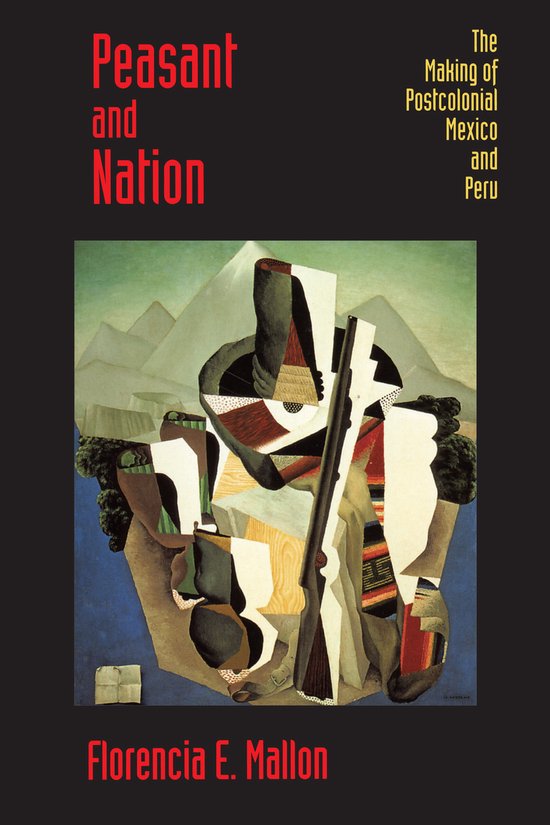
Peasant and Nation
Florencia E. Mallon
- 17 januari 1995
- 9780520085053
Samenvatting:
This text offers a new statement on the making of national politics. Comparing the popular political cultures and discourses of post-colonial Mexico and Peru, it provides an analysis of their effect on the evolution of these nation states.
"A watershed analysis—the new political history of Latin America begins here."—John Tutino, Georgetown University
"Florencia Mallon's analysis of peasant politics and state formation in Latin America compels us to rethink the relationship between the 'national' and the 'popular.' In particular, she questions the concept of 'community' in a way that scholars of subaltern histories elsewhere will find enormously helpful."—Dipesh Chakrabarty, Director of the Ashworth Centre for Social Theory, University of Melbourne, Australia
Peasant and Nation offers a major new statement on the making of national politics. Comparing the popular political cultures and discourses of postcolonial Mexico and Peru, Florencia Mallon provides a groundbreaking analysis of their effect on the evolution of these nation states. As political history from a variety of subaltern perspectives, the book takes seriously the history of peasant thought and action and the complexity of community politics. It reveals the hierarchy and the heroism, the solidarity and the surveillance, the exploitation and the reciprocity, that coexist in popular political struggle. With this book Mallon not only forges a new path for Latin American history but challenges the very concept of nationalism. Placing it squarely within the struggles for power between colonized and colonizing peoples, she argues that nationalism must be seen not as an integrated ideology that puts the interest of the nation above all other loyalties, but as a project for collective identity over which many political groups and coalitions have struggled. Ambitious and bold, Peasant and Nation both draws on monumental archival research in two countries and enters into spirited dialogue with the literatures of post-colonial studies, gender studies, and peasant studies.