
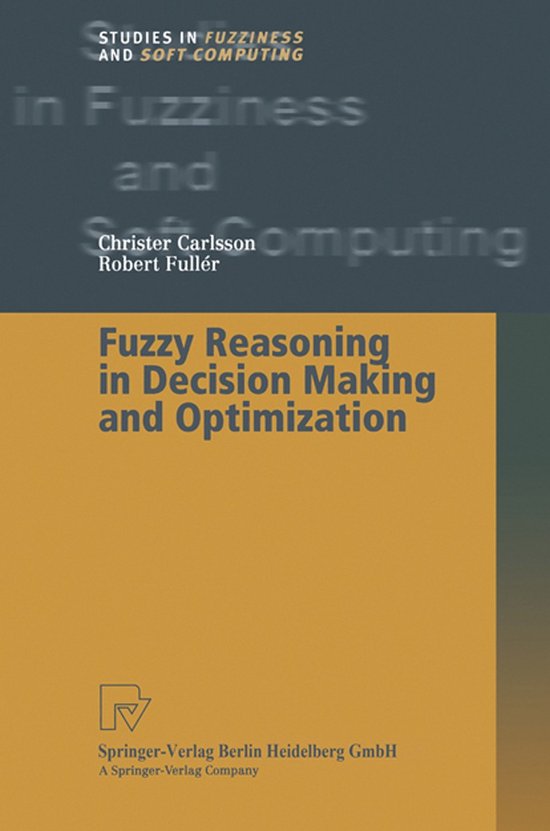
Fuzzy Reasoning in Decision Making and Optimization
Christer Carlsson
- 09 oktober 2001
- 9783790814286
Samenvatting:
Unlike classical logic which requires a deep under standing of a system, exact equations, and precise numeric values, fuzzy logic incorporates an alternative way of thinking, which allows modeling complex systems using a higher level of abstraction originating from our knowledge and experience.
This book starts with the basic concepts of fuzzy arithmetics and progresses through the analysis of sup-t-norm-extended arithmetic operations, possibilistic linear systems and fuzzy reasoning approaches to fuzzy optimization. Four applications of (interdependent) fuzzy optimization and fuzzy reasoning to strategic planning, project management with real options, strategic management and supply chain management are presented and carefully discussed. The book ends with a detailed description of some intelligent software agents, where fuzzy reasoning schemes are used to enhance their functionality. It can be useful for researchers and students working in soft computing, applied mathematics, operations research, management science, information systems, intelligent agents and artificial intelligence.
This book starts with the basic concepts of fuzzy arithmetics and progresses through the analysis of sup-t-norm-extended arithmetic operations, possibilistic linear systems and fuzzy reasoning approaches to fuzzy optimization. Four applications of (interdependent) fuzzy optimization and fuzzy reasoning to strategic planning, project management with real options, strategic management and supply chain management are presented and carefully discussed. The book ends with a detailed description of some intelligent software agents, where fuzzy reasoning schemes are used to enhance their functionality. It can be useful for researchers and students working in soft computing, applied mathematics, operations research, management science, information systems, intelligent agents and artificial intelligence.