
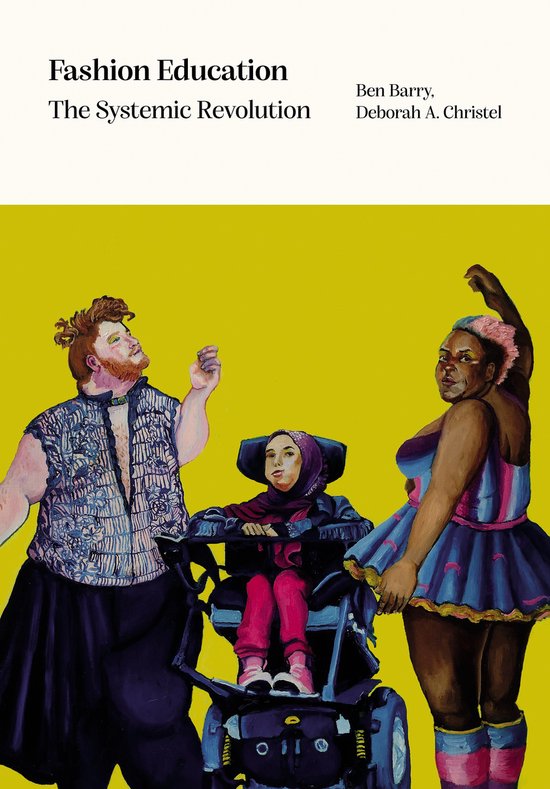
Fashion Education
Ben Barry
- 23 juni 2023
- 9781789386806
Samenvatting:
How fashion education can help create a more inclusive society.
Despite the hard-earned successes of body positive, antiracist, and disability rights activists calling for diverse representation, the fashion industry has been slow to evolve. In Fashion Education: The Systemic Revolution, fashion educators share their experiences navigating, resisting, and transforming the narrow beauty and body ideals that have defined pedagogy within the discipline. The volume examines their challenges and successes, as well as practical strategies for countering narrow fashion education curriculums. Educators share ways to radically redesign courses and decenter white supremacy, fatphobia, ableism, transphobia, and misogyny. Together, the chapters illuminate the critical role of fashion education in systematically eliminating body oppression and building a more inclusive profession.
Ben Barry is dean of the School of Fashion at the New School’s Parsons School of Design. Deborah A. Christel is cofounder of Kade & Vos and head of design and product development at Panty Drop, both fat positive and size inclusive fashion companies.
Fashion Education explores how the classroom can transform the fashion industry towards body inclusion and social justice.
The book is a collection of 17 essays by fashion educators from Australia, Canada, the US and the UK who recount their experiences, struggles and strategies of reimagining the exclusive foundation of fashion pedagogy and redesigning fashion curricula to centre Indigenous, Black, brown, fat, disabled, trans and queer worldviews, histories and bodies.
This is the first book to explore the relationships between fashion pedagogy and social justice, and to map out new pedagogical frameworks and tools to redistribute power through fashion education. It shares the teaching practices of fashion educators implementing radical pedagogies and offers practical case studies that engage with a number of intersectional positions.
Fashion Education engages with current pressing concerns for educators and is a valuable teaching resource for fashion educators – both theory and practice – working in art and design schools in Europe, the US and the UK.
With chapters covering fashion theory, history, business, communication and design curricula to centre Indigenous, Black, brown, fat, disabled, trans, queer worldviews, histories and peoples it will appeal directly to the many disciplines within fashion. The discussions are also relevant to educators in other art, design and creative fields also looking to centre inclusion in their courses and the strategies presented will apply to them.
Contributions from Tanveer Ahmed, Kevin Almond, Avalon Acaso, Ben Barry, Mal Burkinshaw, Johnathan Clancy, Robin J. Chantree, Deborah A. Christel, Brittany Dickinson, Greg Climer, Bianca Garcia, Denise Nicole Green, Alicia Johnson, Lucy Jones, Grace Jun, Carmen Keist, Riley Kucheran, Michael Mamp, Krys Osei, Lauren Downing Peters, Alexis Quinney, Kelly L. Reddy-Best, Austin Reeves, Joshua Simon, Colleen Schindler-Lynch, Brandon Spencer and Sang Thai