
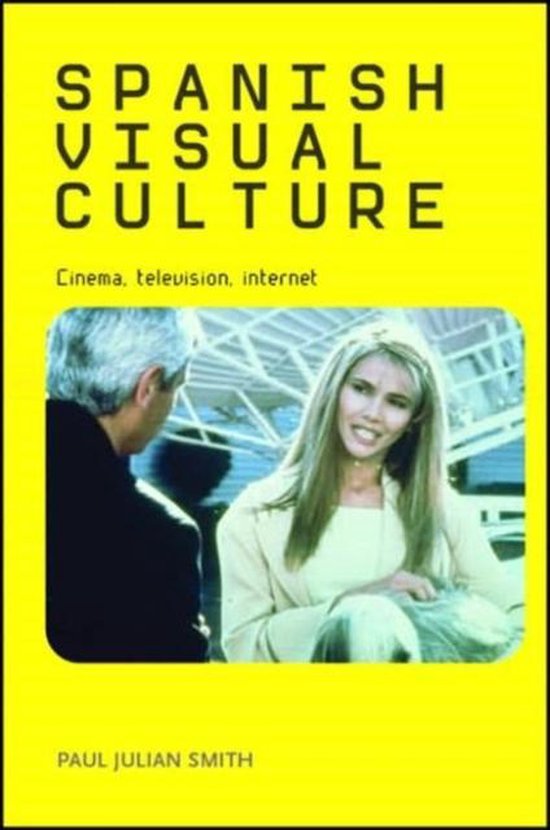
Spanish Visual Culture
Paul Julian Smith
- 30 november 2006
- 9780719075179
Samenvatting:
This book is the first to explore three visual media in contemporary Spain: cinema, television and internet. It also examines cultural products in each of these media in terms of three vital themes: emtion, location and nostalgia.
This book is the first to explore three visual media in contemporary Spain: cinema, television and the internet. It also examines cultural products in each of these media in terms of three vital themes: emotion, location and nostalgia.
The first two chapters focus on emotion. They analyze the ‘emotional imperative’ in a recent Almodóvar feature film and in Spanish television’s top-rated period drama, and investigate the politics of affect in TV drama in the last decade. The next pair of chapters deal with location. They use cultural geography to re-read contradictory accounts of the movida (the post-Franco cultural boom) and examine an attempt to anchor a US-derived genre (the youth movie) in the urban landscape of Madrid. The fifth and sixth chapters introduce the theme of location into nostalgia. They treat the unique cases of a successful Spanish heritage movie and a contemporary Spanish thriller remade in Hollywood. The peunultimate chapter investigates electronic artists and the virtual universe, and the book ends with a look at the implications of Hispano-Mexican co-productions and the interconnectedness of economic and aesthetic cultural forms.
This book is the first to explore three visual media in contemporary Spain: cinema, television and the internet. It also examines cultural products in each of these media in terms of three vital themes: emotion, location and nostalgia.
The first two chapters focus on emotion. They analyze the ‘emotional imperative’ in a recent Almodóvar feature film and in Spanish television’s top-rated period drama, and investigate the politics of affect in TV drama in the last decade. The next pair of chapters deal with location. They use cultural geography to re-read contradictory accounts of the movida (the post-Franco cultural boom) and examine an attempt to anchor a US-derived genre (the youth movie) in the urban landscape of Madrid. The fifth and sixth chapters introduce the theme of location into nostalgia. They treat the unique cases of a successful Spanish heritage movie and a contemporary Spanish thriller remade in Hollywood. The peunultimate chapter investigates electronic artists and the virtual universe, and the book ends with a look at the implications of Hispano-Mexican co-productions and the interconnectedness of economic and aesthetic cultural forms.