
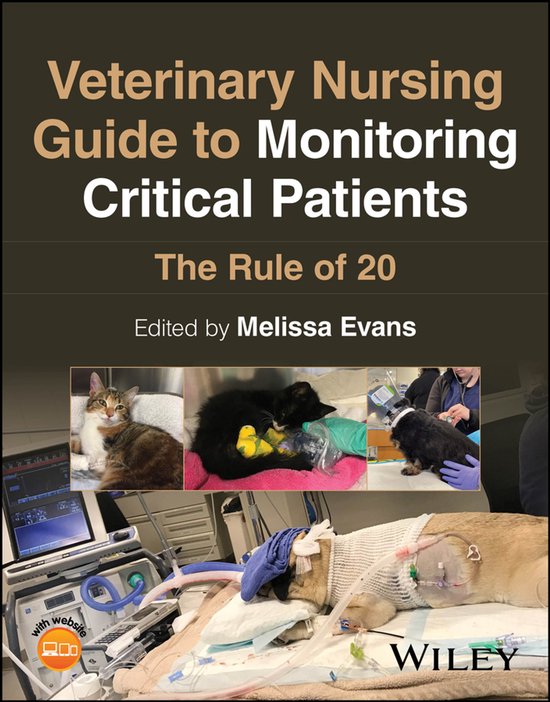
Veterinary Nursing Guide to Monitoring Critical Patients
Melissa Evans
- 30 augustus 2026
- 9781394351275
Samenvatting:
Use the Rule of 20 for critical veterinary monitoring
The Veterinary Nursing Guide to Monitoring Critical Patients: The Rule of 20 examines each parameter in the Rule of 20, a checklist of 20 parameters that should be monitored daily in critical veterinary patients. The book explains what is being monitored and why, with parameters organized in a logical order for creating nursing plans. It emphasizes how each rule affects the others and how to use that knowledge to anticipate patient needs. Each chapter focuses on a single parameter and its practical application and includes a summary of nursing considerations. The book also features examples to illustrate the Rule of 20 fundamentals.
The Veterinary Nursing Guide to Monitoring Critical Patients: The Rule of 20 discusses:
- Fluid balance and colloidal osmotic pressure, oxygenation and ventilation, blood pressure, heart rate,?rhythm, and contractility, and glucose
- Temperature, electrolyte and acid-base balance, mentation, and red blood cell and hemoglobin concentration
- Gastrointestinal motility and mucosal integrity, nutrition, renal function, coagulation, and immune status and antibiotic use
- Drug dosage and metabolism, pain control, nursing care and patient mobilization, wound care and?bandage change, and tender loving care
The Veterinary Nursing Guide to Monitoring Critical Patients: The Rule of 20 is an excellent resource for veterinary technicians, particularly those in Emergency and Critical Care (ECC), to anticipate patient needs and prepare for complications, as well as for technicians working toward their Veterinary Technician Specialty.
The Veterinary Nursing Guide to Monitoring Critical Patients: The Rule of 20 examines each parameter in the Rule of 20, a checklist of 20 parameters that should be monitored daily in critical veterinary patients. The book explains what is being monitored and why, with parameters organized in a logical order for creating nursing plans. It emphasizes how each rule affects the others and how to use that knowledge to anticipate patient needs. Each chapter focuses on a single parameter and its practical application and includes a summary of nursing considerations. The book also features examples to illustrate the Rule of 20 fundamentals.
The Veterinary Nursing Guide to Monitoring Critical Patients: The Rule of 20 discusses:
- Fluid balance and colloidal osmotic pressure, oxygenation and ventilation, blood pressure, heart rate, rhythm, and contractility, and glucose
- Temperature, electrolyte and acid-base balance, mentation, and red blood cell and hemoglobin concentration
- Gastrointestinal motility and mucosal integrity, nutrition, renal function, coagulation, and immune status and antibiotic use
- Drug dosage and metabolism, pain control, nursing care and patient mobilization, wound care and bandage change, and tender loving care
The Veterinary Nursing Guide to Monitoring Critical Patients: The Rule of 20 is an excellent resource for veterinary technicians, particularly those in Emergency and Critical Care (ECC), to anticipate patient needs and prepare for complications, as well as for technicians working toward their Veterinary Technician Specialty.