
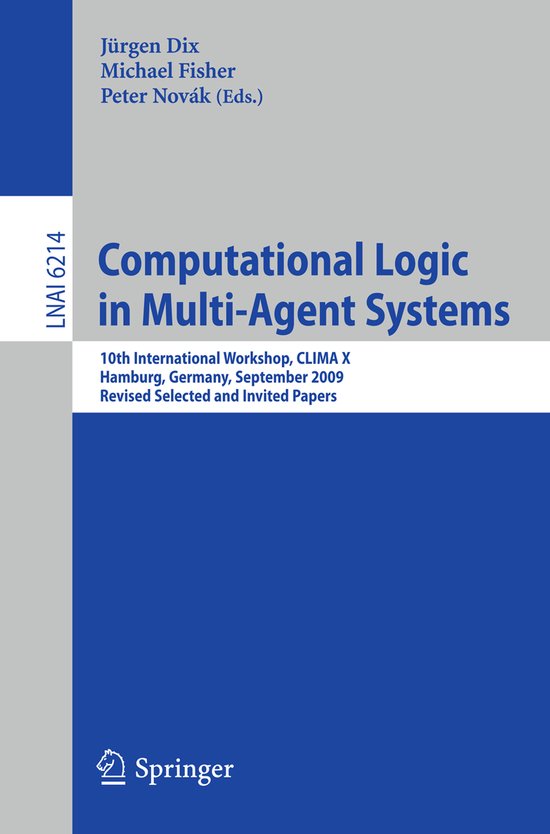
Computational Logic in Multi Agent Systems
- 29 oktober 2010
- 9783642168666
Samenvatting:
These are the proceedings of the 10th International Workshop on Compu- tional Logic in Multi-Agent Systems (CLIMA-X), held September 9-10, 2009 in Hamburg, co-located with MATES. The purpose of the CLIMA workshops is to provide a forum for discussing techniques, based on computational logic, for representing, in a formal way, programming and reasoning about agents and multi-agent systems. Multi-agentsystemsarecommunitiesofproblem-solvingentitiesthatcanp- ceive and act upon their environment in order to achieve both their individual goals and their joint goals. The work on such systems integrates many techno- giesandconceptsfromarti?cialintelligenceandotherareasofcomputingaswell as other disciplines. Over recent years, the agent paradigm gained popularity, due to its applicability to a full spectrum of domains, such as search engines, recommendation systems, educational support, e-procurement, simulation and routing,electroniccommerceandtrade,etc.Computationallogicprovidesawe- de?ned, general, and rigorousframeworkfor studying the syntax, semantics and procedures for the various tasks in individual agents, as well as the interaction between, and integration among, agents in multi-agent systems. It also provides tools, techniques and standards for implementations and environments, for li- ing speci?cations to implementations, and for the veri?cation of properties of individual agents, multi-agent systems and their implementations. These proceedings feature nine regularpapers (from a total of 18 papers s- mitted), as wellas one paper basedonthe invited talk givenby TranCao Son. IntheinvitedpaperbyTranCaoSon,EnricoPontelli,andNgoc-HieuNguyen, "Planning for Multi-Agents Using ASP-Prolog," the action language B is - tended to the multi-agent case. The used technology is based on answer set programming. The contribution by Nils Bulling and Berndt Farwer on "Expressing Prop-