
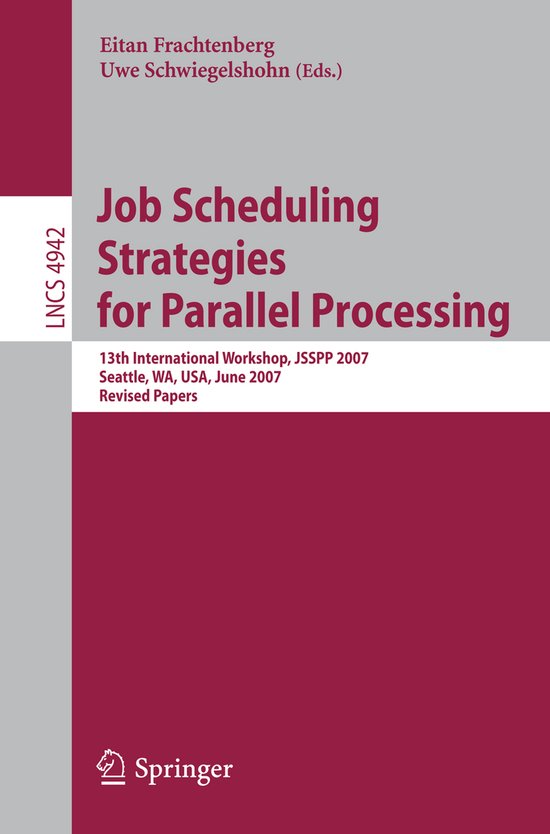
Job Scheduling Strategies for Parallel Processing
Eitan Frachtenberg
- 11 april 2008
- 9783540786986
Samenvatting:
This proceedings volume examines job scheduling strategies for parallel processing from the supercomputer-centric viewpoint. It also addresses many nontraditional high-performance computing and parallel environments that don't access a supercomputer.
This book constitutes the thoroughly refereed post-workshop proceedings of the 13th International Workshop on Job Scheduling Strategies for Parallel Processing, JSSPP 2007, held in Seattle, WA, USA, in June 2007, in conjunction with the 21st ACM International Conference on Supercomputing, ICS 2007.
The 10 revised full research papers presented went through the process of strict reviewing and subsequent improvement. The papers cover all current issues of job scheduling strategies for parallel processing from the supercomputer-centric viewpoint but also address many nontraditional high-performance computing and parallel environments that cannot or need not access a traditional supercomputer, such as grids, Web services, and commodity parallel computers. The papers are organized in topical sections on performance and tools, queueing systems, as well as grid and heterogeneous architectures.
th Thisvolumecontainsthepaperspresentedatthe13 workshoponJobSched- ing Strategies for Parallel Processing. The workshop was held in Seattle, WA, USA, on June 17, 2007, in conjunction with ICS 2007. All submitted papers went through a complete review process, with the full versionbeingreadandevaluatedbyanaverageof?vereviewers.Wewouldliketo thanktheProgramCommittee membersandadditionalrefereesfortheirwilli- ness to participate in this e?ort and their excellent, detailed reviews: Nazareno Andrade, Su-Hui Chiang, Walfredo Cirne, Alvaro Coelho, Lauro Costa, Dror Feitelson, Allan Gottlieb, Andrew Grimshaw, Moe Jette, Richard Lagerstrom, Virginia Lo, Reagan Moore, Bill Nitzberg, Mark Squillante, John Towns, Jon Weissman, and Ramin Yahyapour. The accepted workshop papers in recent years show a departure from the supercomputer-centric viewpoint of parallel job scheduling. On the one hand, the ?eld of supercomputer scheduling is showing some signs of maturity, exh- ited in many widely accepted practices for job scheduling. On the other hand, many nontraditionalhigh-performancecomputing andparallelenvironments are emerging as viable solutions to many users and uses that cannot or need not - cess a traditional supercomputer, such as Grids, Web services, and commodity parallelcomputers.With the growingubiquity ofthese technologies,the requi- ment to schedule parallel jobs well on these various architectures also grows.