
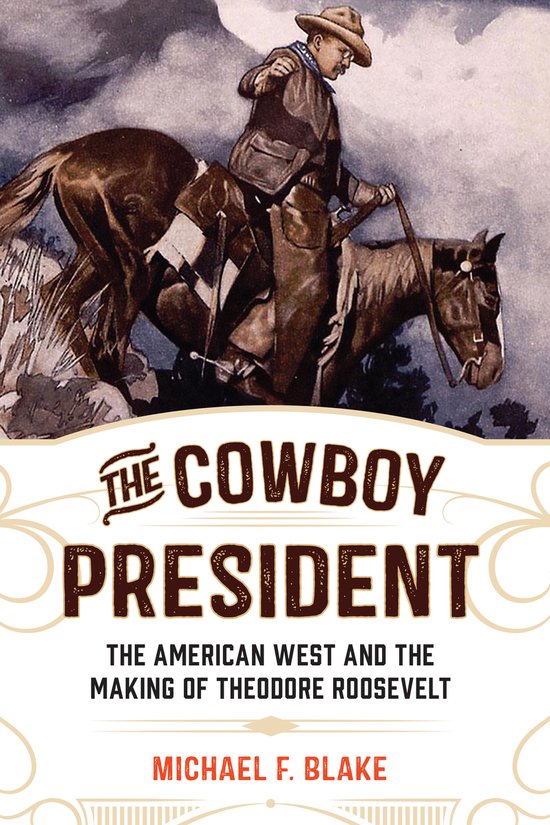
The Cowboy President
Michael F. Blake
- 01 mei 2018
- 9781493030712
Samenvatting:
Reading line: How a U.S. President and the American West Saved Each Other As a boy, Theodore Roosevelt was weak, uncoordinated, asthmatic and often sickly. An avid reader and lover of adventure, he lived vicariously through storybook heroes. By the time he was a young man, he had become the picture of health, embodying strength, toughness and courage. The defining moment for this transition was a tragedy that has brought much stronger men to their knees: the loss of his mother and wife within hours of each other. In the midst of his grief, Roosevelt left behind a waning political career and headed west in search of a physically challenging environment that might help—at least momentarily—to dull the pain of his broken heart. The years he spent in the West helped strengthen not only Roosevelt’s physique, but also his views on conservation and his ability to meet adversity head-on. Indeed, the beauty of the West enchanted him, soothing his grief with a newfound love. For the remainder of his life, Roosevelt remained an ardent supporter of everything the American West embodied. By helping to preserve over 230 million acres of unspoiled land for the American public, President Roosevelt created places where generations continue to find the beauty and solace he treasured. Michael F. Blake is the author of five books and several magazine and newspaper articles, and has made numerous appearances on documentaries. He spent three years researching Theodore Roosevelt’s time in the Dakota Territory, hiking and riding over the same land where he rode over 130 years ago. Blake lives in Los Angeles, California.
The Cowboy President: The American West and the Making of Theodore Roosevelt reveals how his time spent in the Western Dakota Territory helped him recover from an overwhelming personal loss, but more importantly, how it transformed him into the man etched onto Mount Rushmore, a man who is still rated as one of the top five Presidents in American history. Unlike other Roosevelt biographies, The Cowboy President details how the land, the people and the Western code of honor had an enormous impact on Theodore and how this experience influenced him in his later years.