
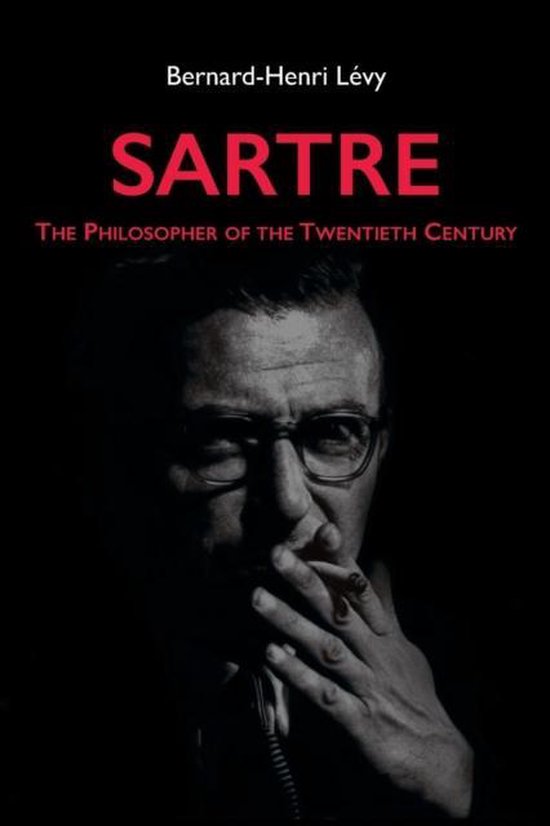
Sartre
Bernard-Henri Levy
- 24 juli 2003
- 9780745630090
Samenvatting:
In this ground--breaking biography, Bernard--Henri Levy shows how Sartre cannot be understood without taking into account his relations with the intellectual forebears and contemporaries, the lovers and friends, with whom he conducted a lifelong debate.
‘A whole man, made of all men, worth all of them, and any one of them worth him.’ This was how Jean-Paul Sartre characterized himself at the end of his autobiographical study, Words. And Bernard-Henri Lévy shows how Sartre cannot be understood without taking into account his relations with the intellectual forebears and contemporaries, the lovers and friends, with whom he conducted a lifelong debate. His thinking was essentially a tumultuous dialogue with his whole age and himself. He learned from Gide the art of freedom, and how to experiment with inherited fictional forms. He was a fellow-traveller of communism, and yet his relations with the Party were deeply ambiguous. He was fascinated by Freud but trenchantly critical of psychoanalysis. Beneath Sartre’s complex and ever-mutating political commitments, Lévy detects a polarity between anarchic individualism on the one hand, and a longing for absolute community that brought him close to totalitarianism on the other. Lévy depicts Sartre as a man who could succumb to the twentieth century’s catastrophic attraction to violence and the false messianism of its total political solutions, while also being one of the fiercest critics of its illusions and shortcomings.
"A whole man, made of all men, worth all of them, and any one of them worth him." This was how Jean-Paul Sartre characterized himself at the end of his autobiographical study, Words. And Bernard-Henri Levy shows how Sartre cannot be understood without taking into account his relations with the intellectual forebears and contemporaries, the lovers and friends, with whom he conducted a lifelong debate. His thinking was essentially a tumultuous dialogue with his whole age and himself. He learned from Gide the art of freedom, and how to experiment with inherited fictional forms. He was a fellow-traveller of communism, and yet his relations with the Party were deeply ambiguous. He was fascinated by Freud but trenchantly critical of psychoanalysis. Beneath Sartre's complex and ever-mutating political commitments, Levy detects a polarity between anarchic individualism on the one hand, and a longing for absolute community that brought him close to totalitarianism on the other. Levy depicts Sartre as a man who could succumb to the twentieth century's catastrophic attraction to violence and the false messianism of its total political solutions, while also being one of the fiercest critics of its illusions and shortcomings.